Building Engaging Kids Activity Books with 25 KIDS MIXED WORD SEARCH Vol 2
Word search puzzles have been a quiet, reliable staple in children’s entertainment and education for decades. They slip easily into backpacks for long car rides, break up screen time during lazy afternoons, and provide a gentle cognitive workout without feeling like schoolwork. For self-publishers and designers creating activity books on Kindle Direct Publishing (KDP), finding the right puzzle interior can mean the difference between a book that gets picked up once and one that becomes a go-to resource for families. The 25 KIDS MIXED WORD SEARCH Vol 2 collection delivers a ready-made, thoughtfully assembled set of puzzles designed specifically for today’s market, balancing fun, challenge, and readability.
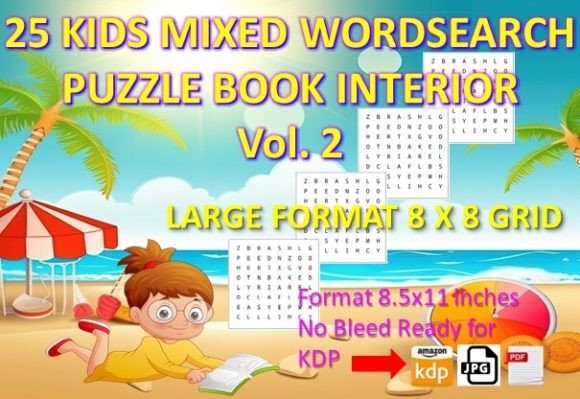
This isn’t a random assortment of grids thrown together in a hurry. Each one of the 25 mixed word search puzzles has been laid out on a generous 8.5×11 inch page, a format that immediately signals quality to a buyer flipping through a physical copy on Amazon. The large dimensions give kids plenty of room to circle words without crowding, and the no-bleed setup ensures that every puzzle prints cleanly without any elements disappearing into a binding gutter or getting trimmed off during production. For creators, that means fewer test prints and a faster path from idea to published book.
What Makes a Word Search Puzzle Book Appealing to Parents and Children?
When a parent or teacher looks for an activity book, they are subconsciously scanning for certain markers of value. A book that feels flimsy, cluttered, or too easy to finish in an afternoon rarely earns repeat usage or positive reviews. The 25 KIDS MIXED WORD SEARCH Vol 2 hits several of those markers naturally. First, the mixed theme approach keeps a child’s interest from puzzle to puzzle, because the vocabulary changes – animals might appear in one grid, sports in another, space terms in a third. This variety prevents the mental fatigue that sets in when every puzzle feels identical.
Second, each puzzle contains between 10 and 15 hidden words. That sweet spot matters. More than 15 words can overwhelm a younger solver who is still building scanning skills; fewer than 10 makes the activity feel too trivial. By sticking to that manageable range, the interior gives kids a sense of accomplishment without demanding an unreasonable attention span. The included answer keys provide that essential moment of self-checking, which fosters independence. A child can verify a stubborn missed word without needing an adult to hover nearby.
Seamless Integration into KDP Publishing Workflows
Self-publishing through KDP has opened the doors for thousands of creative entrepreneurs, but the technical side of formatting can still trip people up. Margins creep, fonts break, and images warp if the source files aren't built correctly. That’s why the delivery format of 25 KIDS MIXED WORD SEARCH Vol 2 deserves attention. You receive both PDF and JPG versions of the interior, which gives you immediate flexibility regardless of your preferred software. Upload the PDF directly to KDP for a print-ready manuscript, or pull the JPGs into Canva, Affinity Publisher, or even PowerPoint if you are building a unique branded package.
The no-bleed specification is a practical detail that experienced publishers will appreciate. Interior pages for puzzle books rarely need to print to the edge of the paper, so a no-bleed layout sidesteps the strict margin requirements that bleed imposes. You can simply upload the file, preview it in KDP’s print tool, and move forward without recalculating extra margins or worrying about important content getting sliced off. This alone saves a significant amount of revision time, especially for those who are new to designing print-on-demand books.
Adapting the Interior to Your Brand and Audience
One of the most valuable aspects of a template like this is that it doesn’t box you in. The pages are meant to be a foundation, not a finished book cover-to-cover. You have full freedom to add your own introduction page, write a cheerful note to parents, place a “This Book Belongs To” ownership page, or weave in some of your own illustrations around the puzzles. Because the files are editable – easily converted using online PDF tools – you can inject your own design language. Change a page title, drop in a decorative border, or intersperse the word searches with connect-the-dots or coloring breaks to create a richer mixed activity book.
Many successful KDP publishers build a series of books around a single character or theme. With the 25 KIDS MIXED WORD SEARCH Vol 2, you might start a “Brainy Kids Activity” line where Volume 1 focuses on mazes, Volume 2 on word searches, and Volume 3 on crossword puzzles. The modular nature of the digital files lets you pick and choose puzzles, combine them with other interiors, and structure a book that feels cohesive and original rather than simply a template with a different cover slapped on. This kind of thoughtful remixing is what separates a bestseller in the children’s activity category from a generic also-ran.
The Cognitive and Emotional Benefits of Word Searches for Kids (and Beyond)
While it is easy to see word searches as pure entertainment, they quietly reinforce several critical skills. Pattern recognition, a cornerstone of early reading development, gets a natural workout as a child scans rows of letters for familiar sequences. Vocabulary exposure widens when puzzles include words like “lantern,” “island,” or “quartz” – terms a child might not encounter in daily conversation but can now connect to a visual search experience. And because word searches have a clear end point, they offer a structured, calming activity for children who feel anxious in open-ended creative tasks.
It would be a mistake to limit the audience of this interior strictly to young children. The term “kids” is in the name, but the clean, large-format design and straightforward word lists make these puzzles accessible to teens who need a low-stakes brain break, adults easing back into mental exercises after an illness, and seniors who enjoy maintaining visual tracking skills. A KDP publisher can easily market the same puzzle base to multiple demographics just by adjusting the cover design and the introductory language. A colorful cover with cartoon animals speaks to six-year-olds; a minimalist, botanical-themed cover with a subtitle like “Relaxing Word Finds for Adults” points the same interior to a completely different buyer. The versatility of the content is one of its strongest hidden features.
Practical Customization Without Advanced Design Skills
If you are comfortable opening a PDF and making minor edits, you have all the technical skill needed to transform these 25 puzzles into a polished product. Tools like Canva Pro’s PDF editor, Adobe Acrobat, or any number of online converters allow you to add text boxes, rearrange pages, and insert additional blank or lined pages for notes. You could, for example, insert a progress tracking page where kids stamp or sticker each completed puzzle – a simple addition that dramatically boosts engagement in a physical book.
The JPG files open up even more creative pathways. You can import the puzzle images into a writing tablet app layout, add a digital frame, and create an e-book version that works with stylus markup. Or, if you sell on platforms like Etsy that cater to printable educational materials, you can bundle selected puzzles into themed mini-packs: 5 Ocean Word Searches, 5 Space Word Searches, and so forth. The digital nature of the product means you are not locked into a single final form; you can repurpose the base assets across multiple products, maximizing your return on a single investment.
Key Technical Specifications That Impact Purchase Decisions
When evaluating any puzzle book interior, buyers (both end-users and publishers) often ask the same silent questions that specifications can answer. Let’s walk through how 25 KIDS MIXED WORD SEARCH Vol 2 addresses them.
- Page size and trimming: The 8.5×11 inch format is letter size, which is the standard for many KDP paperback interiors. It’s large enough to allow a readable font size, usually around 14–18pt for the word list, which is kind to developing eyes. No bleed means you don't have to extend background colors or images beyond the final trim line, simplifying the setup for both paperback and hardcover options.
- Word density per puzzle: With 10 to 15 words per grid, the challenge level stays consistent. This range avoids the frustration of overly sparse puzzles (where a child finishes in a minute) and the overwhelm of dense, 25-word grids better suited to adults. The consistent density also makes it easier for you to write marketing copy that accurately sets buyer expectations.
- Solution pages included: Every puzzle has a corresponding answer page. In a published book, these are typically placed at the end, creating a neat, uncluttered flow. The solution pages are designed in the same clean grid style, so they don’t look out of place. Because they are included, you never have to manually create an answer key, a time-consuming task that often introduces errors.
- Mixed themes: The puzzles are not grouped by strict category, delivering that “mixed” assortment that keeps the book fresh. This reduces the chance of a child getting bored because they “don’t like animals” and avoiding a whole section. Every turn of the page is a surprise.
Blending Word Searches into Larger Mixed Activity Books
While a standalone 25-puzzle book works beautifully as a lightweight travel-sized activity, many of the most successful KDP activity books are compilations. Parents often reach for a single thick book that can occupy a child through a multi-hour flight or a rainy weekend. The 25 KIDS MIXED WORD SEARCH Vol 2 interior integrates effortlessly into such collections. Because you receive the files in universal formats, you can interleave these word searches with coloring pages, mazes, dot-to-dot puzzles, or even simple math riddle pages from other interiors you have purchased or created.
When building a compilation, consider alternating puzzle types every few pages. For example, place four word searches, then a coloring break, then two maze pages, then three more word searches. This rhythm mimics the natural attention variation of a child and keeps the book from feeling monotonous. Since you own the digital files, you can duplicate or reorder puzzles to achieve that rhythm without purchasing additional word search packs. However, for longer books, having a Volume 2 ready allows you to expand without repeating puzzles across volumes, maintaining integrity with your audience who may buy the whole series.
SEO and Market Positioning Considerations for Your Final Product
If you plan to sell the finished puzzle book on Amazon, the keywords you choose and the way you present the interior in your listing’s description will determine visibility. Because the puzzles are kid-focused but adaptable, you can legitimately target multiple search terms. A few semantically relevant phrases that pair naturally with this interior include: “large print word search for kids ages 6-9”, “travel activity book for children”, “homeschool brain break puzzles”, “screen-free entertainment for long trips”, and “easy word finds with answers”. In your product description, you can truthfully state that the book contains 25 carefully designed puzzles printed in jumbo 8.5×11 format, each with a manageable word list and full solutions provided.
The fact that the interior is editable also means you can tailor the final book’s metadata more precisely. Let’s say your research shows strong demand for “dinosaur activity books for boys age 7.” You could take the base puzzles, add a few hand-drawn dinosaur icons around the margins, rename the book accordingly, and publish a version that directly speaks to that niche. The core puzzle quality remains unchanged, but the packaging aligns perfectly with a hungry market segment. This adaptability, powered by the editable PDF and JPG source files, turns a single puzzle interior into a engine for multiple niche products.
Creating a Cohesive Customer Experience from First Look to Last Puzzle
Beyond the puzzles themselves, think about the flow of the book you will create. The downloaded files from 25 KIDS MIXED WORD SEARCH Vol 2 don’t include a cover or an introduction page, which is actually a benefit. It means you start with a clean slate. Craft an introduction page that encourages kids to circle each word with a different color, or challenge them to time themselves and try to beat their record on the next puzzle. Add a simple certificate of completion at the end – a single page that says “Congratulations, Word Search Champion!” – and you have just elevated the perceived value of the book significantly. Little touches like these lead to positive reviews and buyer loyalty, which are gold in the KDP ecosystem.
The 8.5×11 size also invites interaction. A child can lay the book flat on a table, use a highlighter, and even prop it up to show a parent their completed grid. The no-bleed design ensures that even if a child colors aggressively around the edge of the page, the puzzle grid remains intact. This durability in design is subtle but important; a puzzle that feels resilient invites more enthusiastic use.
Comparing Digital and Print Usage Scenarios
While KDP is often associated with physical books, the JPG files open up digital horizons. Teachers can use selected puzzles as interactive whiteboard warm-ups when projected onto a screen. Parents homeschooling on a tablet can import the JPG into a PDF annotation app and let their child finger-trace the words digitally, reducing paper waste. For occupational therapists working on visual scanning with pediatric clients, having a large, clear word search grid that can be printed on-demand is a valuable resource. The digital download format means you can keep the files indefinitely, printing fresh copies as needed without the degradation of a photocopied sheet of a sheet.
Publishers who operate in the Teachers Pay Teachers or Etsy printable space can leverage this same flexibility. You can create a listing for “25 Mixed Word Search Printables – Large Format” and sell the digital file directly to educators and parents who want instant access. The no-bleed 8.5×11 size is exactly what they expect for home printing, and the included answer keys add professional polish that drives positive ratings.
Why Volume 2 Matters for Series Builders
If you have already used an earlier puzzle interior, the Volume 2 designation signals continuity. Buyers who enjoyed the first book will look for a second that offers fresh content without a jarring change in style or difficulty. 25 KIDS MIXED WORD SEARCH Vol 2 maintains the same large format, answer key inclusion, and mixed theme approach, so it slots into your series naturally. You can even cross-promote within your books by including a page at the back that reads, “Loved these puzzles? Check out Vol 1 and Vol 3 for more word search fun!” This kind of internal marketing costs nothing and can double your per-customer revenue over time.
For a new publisher, starting with Vol 2 can be a smart move because it allows you to release Vol 1 at a later date, creating a backlog effect. A customer finding Vol 2 might then see Vol 1 in your author catalogue and pick up both. The numbering gives the impression of a complete, curated product line, which builds trust far more effectively than a single, standalone offering.
Word searches endure because they are simple, satisfying, and adaptable. The 25 KIDS MIXED WORD SEARCH Vol 2 interior brings the structural reliability that KDP publishers need – proper formatting, editable source files, and an intelligent puzzle density – wrapped in a kid-friendly design that can be reimagined across audiences. Whether you are building a full-scale mixed activity tome, a compact travel companion, or a digital printable store, this set of 25 puzzles provides a flexible foundation that saves you from the grind of puzzle creation and lets you focus on packaging, marketing, and growing your publishing brand.