Master Tactical Vision with 4600 Easy Medium Puzzles in One Move
Chess is no longer confined to quiet clubs or dusty bookshelves. It has surged into everyday life through streaming, casual mobile games, and a growing appetite for analog hobbies that sharpen the mind away from glowing screens. At the center of this revival sits a deceptively simple skill: pattern recognition. The ability to spot a winning combination in a single move separates tentative beginners from confident intermediate players. The 4600 Easy Medium Puzzles in One Move collection directly addresses this skill gap with an approach that feels both timeless and perfectly aligned with modern learning preferences. This is not just a book; it is a self-contained training system delivered as a printable digital download, ready to adapt to your goals, your printer, and even your commercial ambitions.
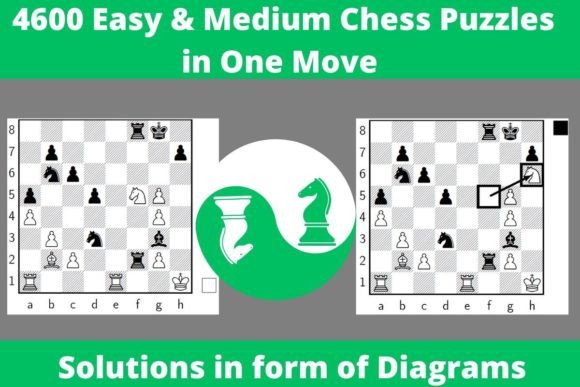
What exactly is this resource? It consists of two PDF files packed with 4600 chess puzzles, all presented as clear diagrams with solutions. Every puzzle demands a single move to achieve a decisive advantage—checkmate, a winning material gain, or a critical tactical blow. The difficulty spans from Easy (around 1000 ELO) to Medium (up to roughly 1500 ELO), creating a gradual slope that builds confidence while never allowing complacency. Because the entire package is a digital download, you receive it instantly, print it on standard letter or A4 paper, and reuse it endlessly. Whether you are a hobbyist, an educator, a content creator, or an entrepreneur looking for print-on-demand assets, this product sits at a fascinating intersection of self-improvement and opportunity.
Why Tactical Repetition Matters More Than Ever
Modern life fragments attention. We consume information in short bursts, often sacrificing depth for speed. Chess, by contrast, rewards sustained focus and the kind of intuitive recognition that only comes from seeing thousands of patterns. The one-move puzzle format is uniquely suited to this era precisely because it contradicts its worst habits. Each puzzle demands total concentration for ten to thirty seconds, then offers an immediate dopamine hit of the solution. Over time, the brain begins to recognize knight forks, back-rank weaknesses, discovered attacks, and smothered mates not as abstract concepts but as visual instincts. Professionals in finance, technology, and creative fields often describe this as building a mental library of patterns—a resource that translates surprisingly well into faster decision-making in their daily work.
Printing these puzzles on actual paper introduces another advantage: screen-free focus. Many users of the 4600 Easy Medium Puzzles in One Move collection deliberately move their study time away from tablets and laptops. Setting up a physical board or simply solving directly on the printed diagram slows down the thought process in a beneficial way. You cannot rush through a printed page with the same frantic clicking you might apply to an app. The tactile experience reinforces memory retention, a phenomenon supported by research on handwriting and printed learning materials. In a world that pushes everything toward digital interfaces, this printable format becomes a deliberate act of cognitive hygiene.
The Gradual Climb from 1000 to 1500 ELO
Structured progression is often missing from free online puzzle generators. Many random puzzles oscillate wildly in difficulty, frustrating learners and failing to build reliable skills. This collection sequences its material deliberately. The easy section begins around the 1000 ELO range, where the winning move often involves a straightforward capture, a simple checkmate in one, or a basic pin. These puzzles are not trivial for a true beginner; they assume you already understand fundamental chess rules, piece movements, check, and checkmate. That prerequisite ensures the material starts at a meaningful point and avoids wasting time on absolute basics.
As you advance, the medium puzzles creep toward the 1500 ELO level. The patterns remain one move deep, but the board situations become more cluttered. A discovered attack might be masked by several pieces; a fork might require noticing that the queen and rook are awkwardly placed on the same color complex. By working through these 4600 easy and medium chess puzzles systematically, you gradually internalize the spatial relationships that define club-level play. A frequent observation among adult improvers is that they see a noticeable jump in their rapid and classical ratings after a few hundred puzzles, simply because they stop missing one-move tactical shots during actual games. This collection provides enough volume to make that jump sustainable, not a fleeting spike.
Digital Downloads and the New Learning Economy
The way people acquire knowledge has shifted toward unbundled, just-in-time resources. Instead of committing to a full course or a thick textbook, learners often prefer targeted tools that solve a specific problem. This puzzle set fits that model perfectly. Someone who constantly blunders in winning positions can download, print, and drill these one-move checkmate puzzles without wading through opening theory or endgame manuals. The PDF format means no shipping costs, no waiting, and no shelf space consumed. You purchase, you download, and within minutes you can be solving at your kitchen table.
This immediacy aligns with the expectations of busy adults aged 20 to 50. A freelance graphic designer might print a few pages before a client call to reset her mental clarity. A business owner might keep a folder of printed puzzles in his bag for airports or coffee breaks. The resource never expires. You can print the same puzzle set multiple times, revisit it after six months, or share pages with a study group (for personal use). This reusable, non-consumable nature changes the value calculus. It is not a one-time workbook but a lifelong reference that can be refreshed on demand.
Beyond Personal Study: Commercial Possibilities and the Creator Economy
One of the most striking aspects of this listing is the explicit permission for commercial use. You are allowed to use these chess puzzle templates commercially, including selling them on print-on-demand platforms like KDP (Kindle Direct Publishing). This transforms the product from a mere study aid into a business asset. Coaches can incorporate printed puzzle sheets into their paid training packets. Bloggers and niche site owners can create puzzle books or printable products for their audience. A chess enthusiast with an Etsy store can design a unique puzzle journal using these diagrams, adding branding and packaging to serve a market hungry for offline activities. The fact that these are clean diagrams, free from branding or watermarks, makes them incredibly flexible raw material.
Consider the current surge in print-on-demand publishing. Low-content and medium-content books—puzzle books, logbooks, journals—consistently rank among the steady sellers on KDP. However, many aspiring publishers struggle to source legitimate, high-quality interior content. The 4600 chess puzzles with solutions in this package solve that problem directly. You can curate a selection of 100 or 200 puzzles, format them into a book, add a cover, and publish. Because you can print or reproduce the files as often as you like, the creative possibilities extend across multiple projects. The only real requirement is understanding the fundamental chess rules yourself to ensure you position the material appropriately for buyers. This lowers the barrier to entry for chess-themed content creation while providing real value to end users who will inherit the same well-structured tactical training.
Print, Solve, and the Analog Renaissance
There is a quiet but powerful movement toward analog tools in an increasingly digital world. Board games, physical books, puzzles on paper, and handwritten planning have all seen renewed interest among people who spend their workdays staring at monitors. Chess puzzles fit beautifully into this trend. A printed sheet of easy medium puzzles in one move offers a contained, satisfying experience. It has a beginning and an end. It does not ping, refresh, or demand updates. It demands nothing except attention. Many users report that solving printed puzzles feels more rewarding than clicking through an app, even if the core activity is similar. The kinesthetic element of moving a pencil, circling a move, or even just physically flipping the page seems to cement learning more effectively.
From a lifestyle perspective, this printable resource supports mindful breaks. Instead of scrolling social media during a pause, someone can solve five or ten puzzles. The difficulty range ensures that it remains neither overwhelmingly hard nor boringly simple. The quick feedback loop—check the solution, move on—mimics some positive aspects of digital interaction without the algorithmic baggage. Coaches and educators who work with adult learners often leverage this by assigning a printed puzzle sheet as a warm-up before a lesson, effectively transitioning the brain into a tactical mindset without digital distraction.
Practical Implications for Different Users
Let’s examine how this collection lands in real-world scenarios. A marketing professional with a 1200 online rating might spend 15 minutes each morning solving two printed pages. Over three months, that adds up to over a thousand puzzles. The improvement is not magic; it is exposure. By the end, back-rank mates become as obvious as a red light. An entrepreneur running a chess coaching side hustle can print weekly homework packets for students, customizing the mix of easy and medium puzzles based on each student’s level. The infinite reprint license means no ongoing costs for this material. A KDP publisher can select 4600 one-move puzzle diagrams to create a niche book titled “180 One-Move Checkmates for Club Players,” format the interior with solutions on the following page, and launch within days. Each of these use cases draws on the same core asset but derives unique value from it.
It is important to note the prerequisite clearly stated in the listing: you must understand all fundamental chess rules. This is not a learn-to-play product. It assumes you know how pieces move, what checkmate means, and the basic objective of the game. This is actually a strength. Many puzzle books either over-explain basics and clutter the experience or assume too much and lose beginners. By clearly anchoring at “1000 ELO easy,” the collection targets the exact demographic that struggles with tactical blindness after grasping the rules. These are the players who know what a fork is but still overlook it in a game. The focused, no-hand-holding nature respects their intelligence and time.
Contextualizing the 4600 Figure: Quality Through Volume
The number 4600 might initially sound overwhelming, but it is actually a deliberate design choice that addresses a common pain point: puzzle repetition. Shorter collections often cycle the same motifs quickly, leading to memorization rather than genuine pattern recognition. With 4600 distinct positions, you can cycle through the material multiple times without the brain simply recalling a specific diagram. The continuity of seeing fresh arrangements of the same tactical themes—pins, skewers, double attacks, clearance sacrifices—builds a robust, flexible intuition. This volume also makes the commercial use case viable. A publisher needs a deep well of content to draw from without resorting to filler or duplicate patterns. The two-book structure (combined into two PDFs) allows for organized access, with easy puzzles in one file and medium in the other, further streamlining project-based selection.
For the individual learner, the sheer volume supports a healthy habit without pressure. You don’t need to finish; you just need to start. The books are not consumable, so diving in and out, skipping around, or repeating a difficult set carries no penalty. This lowers the psychological barrier that comes with expensive courses or single-use workbooks. It is a resource designed for the way adults actually learn—iteratively, asynchronously, and driven by curiosity rather than a rigid syllabus.
The Intersection of Technology and Tactile Learning
We often treat digital and physical as opposites, but this product thrives on their synergy. The delivery is digital, instant, and global. The consumption is physical, deliberate, and personal. That fusion respects the user’s reality: you likely discovered the product online, purchased it during a quick transaction, but you’ll engage with it offline, possibly with a cup of coffee, free from notifications. This pattern repeats across many modern learning tools. Printable PDF chess puzzles occupy a sweet spot where they leverage the efficiency of e-commerce and digital storage while honoring the cognitive benefits of paper. For creators who modify the files into commercial products, this digital-to-physical pipeline becomes a business model. They buy a digital asset, transform it into a physical or print-on-demand product, and sell it to customers who crave tangible goods. The underlying chess content supports genuine value, not empty filler.
As remote work blurs the boundaries between home office and personal space, hobbies that can be picked up and put down quickly gain outsized importance. A chess puzzle sheet on a standing desk can be a five-minute mental reset. Because the puzzles are in one move, they never become a time sink. You can pause after any puzzle without losing context. This microlearning format fits into scattered attention spans without degrading the depth of skill acquisition. It is, in many ways, the ideal cognitive snack.
Observations and Recommendations
If you are considering this collection solely for personal improvement, pair it with a real board. Solve on the printed page, then physically execute the move on the board. This multisensory reinforcement accelerates pattern acquisition. Focus on accuracy first, speed later. The easy puzzles should eventually be solvable at a glance; the medium puzzles may require a few seconds of calculation. Track your progress informally. Are there themes you consistently miss? Go back through the medium file and isolate puzzles featuring those motifs. Because you can reprint, you can literally cut and paste (or digitally select) specific pages for targeted drills.
For commercial usage, start with a clear concept. A pure puzzle book without solutions on the same page works for some niches; a coaching workbook with space for annotations suits another. The files give you raw puzzle diagrams and solutions, so you control formatting, page layout, and the ratio of puzzles to explanations. Always add value through design, curation, or instructional supplements that reflect your brand. The 4600 Easy Medium Puzzles in One Move collection provides the core tactical engine; your creativity builds the vehicle. This model—buying high-quality digital assets and remixing them—is increasingly common among entrepreneurs who prioritize speed to market while maintaining product integrity.
Ultimately, this resource thrives because it meets genuine needs without overpromising. It does not claim to create grandmasters. It promises 4600 clean, graduated puzzles that build tactical sight when solved consistently. In an era filled with learning tools that demand subscriptions, harvest data, or disappear with platform changes, a downloadable PDF that you truly own feels quietly radical. It puts control back in your hands, whether those hands hold a pencil, a printed booklet, or the reins of a small creative business.