Understanding the 50 Kids Mixed Word Search Vol 4 Puzzle Book Interior for KDP Publishing
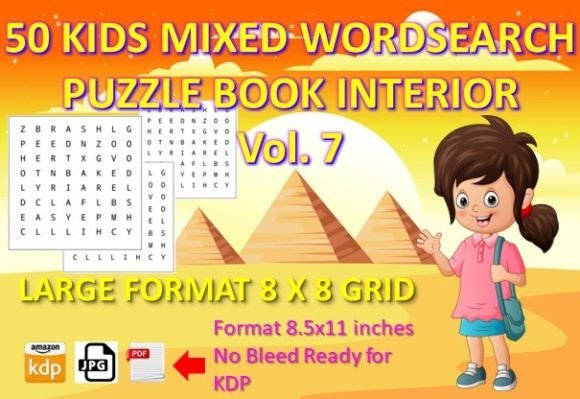
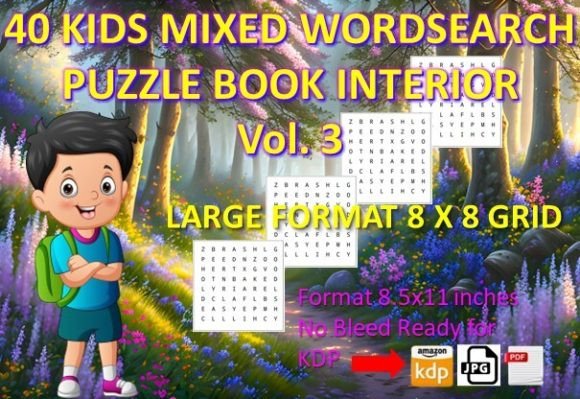
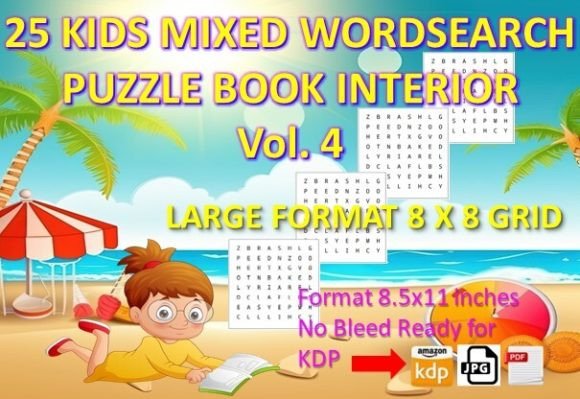
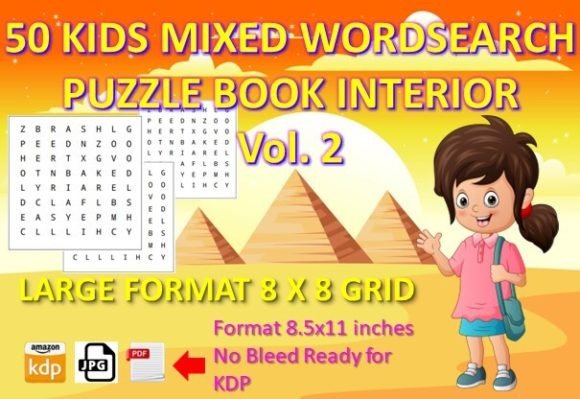
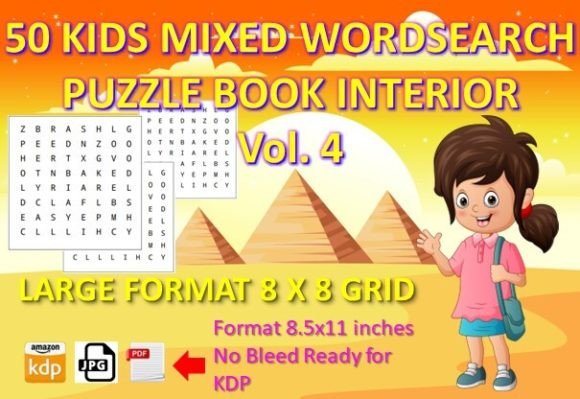
Puzzle activity books continue to hold steady demand in the print-on-demand marketplace, and 50 KIDS MIXED WORD SEARCH Vol 4 enters this space as a ready-made interior template designed specifically for Amazon KDP and similar platforms. Rather than building word search grids from scratch, publishers can start with a preformatted document that handles layout, puzzle distribution, and solution placement. The core proposition is practical: fifty distinct word search puzzles, each containing up to fifteen themed words, delivered as editable PDF and JPG files sized precisely for 8.5×11 inch trim with no-bleed formatting.
What separates a usable puzzle interior from a frustrating one often comes down to formatting consistency and answer accessibility. This volume includes all solutions within the file, so buyers do not need to create separate answer keys or verify puzzle accuracy before publishing. The immediate benefit is time saved on grid generation and page layout, tasks that can consume hours when handled manually or through consumer-grade puzzle software. For someone producing multiple activity books per month, that time savings compounds meaningfully.
What the Interior Template Actually Contains
The package centers on fifty mixed word search puzzles built around kid-friendly vocabulary. The "mixed" descriptor indicates thematic variety rather than a single subject focus, which tends to perform well in broad-audience activity books aimed at children, families, or casual puzzlers. Each puzzle offers up to fifteen searchable words, a count that balances engagement with accessibility for younger solvers while remaining substantial enough for older children, teens, and adults who enjoy lighter puzzle sessions.
Technical specifications matter when preparing print-ready interiors. The 8.5×11 inch large format suits activity books well, providing ample space for letter grids without crowding. The no-bleed designation means all content stays within standard margins, reducing formatting headaches during upload to KDP or IngramSpark. Receiving both PDF and JPG formats adds flexibility—PDF works directly for most print-on-demand uploads, while JPG files allow for insertion into design software like Canva, Affinity Publisher, or Adobe InDesign for further customization.
Why Preformatted Puzzle Interiors Appeal to KDP Sellers
Anyone who has created puzzle books from scratch understands the hidden labor involved. Word search generation requires algorithmic thinking or specialized software, and even after generating grids, the manual work of checking for unintended words, spacing consistency, and answer key accuracy remains. 50 KIDS MIXED WORD SEARCH Vol 4 eliminates that front-end labor, positioning itself as a production tool rather than a finished product. Experienced sellers often treat such templates as raw material, layering their own branding, introduction pages, cover designs, and additional content to build unique final products.
The editable nature of PDF files means you can reorder pages, remove specific puzzles, or extract sections to blend with other content. Someone building a larger mixed activity book might pull ten word searches from this volume, combine them with mazes from another source, add coloring pages, and produce a comprehensive kids' activity compilation. The template serves as a modular component in a broader publishing workflow.
Strengths Worth Noting
Several practical advantages emerge upon examining the feature set:
- Complete solution integration removes the separate step of answer key creation. Every puzzle has its corresponding answer page, reducing the chance of publishing incomplete or mismatched content.
- Large format compatibility aligns with standard activity book dimensions, avoiding the scaling issues that sometimes arise when repurposing smaller-format puzzles for 8.5×11 trim.
- Dual file formats accommodate different workflows. PDF suits direct uploads or basic edits through online converters, while JPG provides pixel-based assets for more visual customization.
- Fifteen-word maximum per puzzle creates a consistent difficulty curve. This prevents puzzles from becoming unwieldy while keeping younger solvers engaged without frustration.
- No-bleed design simplifies the technical side of print preparation, particularly for sellers new to publishing who may not yet be comfortable managing bleed settings.
The design also considers versatility across age groups. While titled for kids, the word list difficulty and grid sizes can serve teens, adults, and seniors looking for moderate-challenge puzzles. This demographic flexibility increases the potential market reach for a single interior template. A publisher could market nearly identical puzzle content to different audiences simply by adjusting the cover design and marketing language.
Real-World Use Cases and Scenarios
Consider a freelance designer who manages KDP accounts for multiple clients. Building custom puzzle books from scratch for each client becomes unsustainable at scale. A template like 50 KIDS MIXED WORD SEARCH Vol 4 functions as a reusable asset, adapted per project by changing fonts, adding themed illustrations, or reordering content. One client receives a dinosaur-themed puzzle book featuring these word searches alongside dinosaur facts and coloring pages. Another client gets an ocean-themed version using the same base puzzles but entirely different visual wrapping.
Educators and homeschool content creators represent another user segment. A teacher creating supplementary activity materials might incorporate selected puzzles into lesson plans, printed handouts, or digital learning packets. Because the files are editable, they can extract individual puzzles rather than using the entire set, adding custom instructions or vocabulary hints relevant to specific learning objectives.
Small business owners in the party supplies or gift niche can adapt the puzzles for activity placemats, travel entertainment booklets, or seasonal gift sets. The editable format means puzzles can be resized, cropped, or arranged into different layouts beyond the standard 8.5×11 book page.
Quality and Consistency Considerations
The reliability of puzzle interiors affects both customer experience and review profiles. Word searches with errors—misspelled words, missing answers, unsolvable grids—generate negative feedback quickly. Pre-built interiors shift quality assurance partially to the template creator, though publishers should still proof all pages before publication. The up-to-fifteen-word structure provides enough variance to avoid repetition between puzzles while remaining manageable for the target solver.
Consistency across fifty puzzles matters for perceived professionalism. Pages that follow identical margin layouts, font sizing, and grid spacing create a cohesive reading experience. The no-bleed specification supports this consistency by maintaining predictable borders throughout the document, reducing the risk of content shifting or truncation during printing.
One practical limitation buyers should understand: this package includes only the puzzle interior. Cover designs, introductory pages, advertising inserts, and any additional front or back matter fall outside the template scope. This is standard for puzzle interiors and allows maximum creative freedom, but it means the download is a component rather than a complete publishable book. Publishers must invest additional effort in branding and packaging before listing the final product.
Customization Potential and Flexibility
The ability to edit through online PDF converters or desktop software makes the template accessible even to those without advanced design skills. Simple edits like adding page numbers, adjusting titles, or inserting a copyright page require basic PDF editing knowledge. More ambitious customizations—incorporating the puzzles into an existing branded template, adding spot illustrations, or reformatting for different trim sizes—benefit from graphic design software experience.
Publishers who maintain a consistent brand aesthetic across their catalog can apply brand colors, fonts, and layout touches to these puzzles, creating visual continuity with other titles. The template serves as structural scaffolding rather than a finished visual product, which aligns with how serious publishers prefer to work. Pre-styled interiors often require undoing design choices to match branding; a straightforward template avoids that extra step.
Adding or deleting pages provides another layer of control. A seller might reduce the book to thirty puzzles for a shorter, lower-priced offering, or expand it by combining with mazes, crosswords, or coloring content from other sources. The flexibility to treat individual puzzle pages as modular units rather than fixed sequences supports creative product development across multiple niches and price points.
Who Gains the Most Value
The strongest fit exists for KDP publishers building activity book catalogs with moderate to high output frequency. Those releasing one or two puzzle books annually might prefer creating fully custom interiors, but sellers targeting quarterly or monthly releases benefit substantially from template efficiency. The time recovered from puzzle generation can shift toward market research, cover design optimization, advertising, or content expansion.
Content creators who bundle activity books with other products also find practical value. An author selling a children's fiction series might offer a companion activity book featuring these word searches, strengthening product ecosystems and increasing per-customer value. Coaches, therapists, and recreational program directors who create client-facing materials can incorporate the puzzles into worksheets or session handouts.
Beginners entering KDP publishing encounter a gentler learning curve when starting with preformatted interiors. Rather than simultaneously mastering puzzle creation, book formatting, cover design, and platform requirements, they can focus on presentation and marketing while working with technically sound puzzle content. The editable format also allows for course correction—if initial formatting choices don't work, adjustments are possible without starting over.
Potential Limitations to Consider
The word search niche is competitive, and using third-party interiors means other sellers may publish books built on the same puzzle set. Differentiation through cover design, branding, additional content, and niche targeting becomes essential. A generic presentation of identical puzzles will struggle against unique offerings. Publishers should view the template as a starting point requiring significant value addition rather than a finished solution.
Without sample pages visible before purchase, buyers must rely on descriptions regarding puzzle quality and design. The up-to-fifteen-word structure is clearly stated, but details like font choice, grid styling, and page layout aesthetics remain unspecified until download. This represents a common tension in template purchases across all creative marketplaces.
The no-bleed design, while simplifying production, limits visual options for edge-to-edge decorative elements that some activity book publishers prefer for premium positioning. Those targeting high-end puzzle book markets with elaborate visual design may find the format constraints limiting.
Making the Most of the Template
Experienced publishers tend to approach such interiors as infrastructure rather than product. The smart workflow involves importing the puzzles into a master design file, adding branded elements, writing original front matter that speaks to the target audience, and wrapping everything in a professionally designed cover that accurately represents the content difficulty and theme. The puzzles themselves become one ingredient in a larger package that reflects the publisher's market understanding and aesthetic judgment.
Testing different niche applications before committing to a large print run or heavy advertising spend allows for data-driven expansion. A publisher might release a general kids word search book using the full fifty puzzles, then monitor which age groups and keywords drive sales, using that intelligence to inform future adaptations of the same puzzle set for more targeted audiences.
The inclusion of JPG files opens multimodal publishing opportunities. Beyond print, the puzzle images can populate digital download products, printable Etsy listings, or membership site content libraries. A single interior purchase can support revenue streams across multiple platforms when paired with appropriate licensing and repurposing strategies.
For the practical publisher focused on efficient production of quality puzzle content, 50 KIDS MIXED WORD SEARCH Vol 4 offers a functional foundation that rewards creative layering and market-aware positioning. The template handles the technical puzzle creation so publishers can direct their energy toward the elements that actually differentiate products in a crowded marketplace: audience understanding, visual presentation, and marketing precision.