Unlocking Early Math Skills: A Deep Dive into Number Tracing Pages for Preschool and Kindergarten
There is a quiet magic in watching a small hand grip a crayon for the first time and trace a wobbly number two across a fresh sheet of paper. That singular moment bridges the gap between abstract thought and physical skill. It is the foundation of numeracy, fine motor control, and the confidence to say, “I did it.” For parents, teachers, and even savvy Amazon KDP publishers, children number tracing pages represent more than simple worksheets—they are carefully engineered tools for early cognitive development. Whether you are focusing on the foundational digits 1 through 10 or advancing into the teen numbers like 19 and 20, the methodology behind these print-ready resources deserves a closer look.
In this comprehensive guide, we will explore why number tracing remains a cornerstone of early childhood education, how print-ready KDP files are revolutionizing access to these resources, and exactly what makes a high-quality tracing workbook effective. If you are looking to help a kindergartner master counting or seeking a ready-to-publish interior for passive income, understanding the anatomy of these pages is your first step.
The Science Behind Number Tracing: Why It Works
Learning to write numbers is not an instinctive biological process like learning to walk. It is a complex neurological task requiring the synchronization of visual perception and fine motor mechanics. When a child uses a number tracing page, they are engaging in a practice known as guided multisensory learning.
Building Fine Motor Foundations
Before a child can solve complex equations, they must master the pincer grip. Tracing the curves of a 3 or the straight lines of a 1 strengthens the intrinsic muscles of the hand. This physical preparation is essential for later writing stamina. Without it, a child entering elementary school may struggle not just with math, but with any task requiring sustained hand control. This is why occupational therapists often recommend tracing activities for preschool-aged children.
Visual-Motor Integration
Number tracing pages serve as a bridge between the eye and the hand. When a child sees the bold outline of a number 7 and attempts to follow the dotted path, they are sharpening their visual-motor integration. This skill is the bedrock of reading and spelling. The specific practice of moving from the top to the bottom and left to right—inherent in tracing—also indirectly reinforces the directionality required for fluent reading in English.
Number Recognition and Cognitive Load
For a young mind, distinguishing a flipped 6 from a 9 or a looping 2 from a 5 is a major cognitive achievement. By tracing the digits physically, the brain forms a "motor memory" of the shape. This reduces the cognitive load required to identify the symbol later. The child no longer has to consciously puzzle out the squiggle; they simply feel the number. This foundational confidence is what makes resources like a 1 to 10 number tracing book so valuable in a kindergarten or homeschool setting.
Anatomy of an Effective Print-Ready Tracing Page
Not all tracing worksheets are created equal. A generic black-and-white sheet with tiny dotted lines fails to captivate a modern child saturated with sensory stimuli. However, a print-ready KDP file designed with educational psychology in mind can be a game-changer. Let’s dissect the key elements that transform a simple template into a high-converting, educational asset, focusing on specs like 8.5 x 11 inch paper with no bleed.
The Sweet Spot: Specs and Formatting for KDP
If you are creating or purchasing a file for Amazon KDP, the technical specifications are the silent pillars of quality. A standard 8.5 x 11 inch trim size is the gold standard for educational workbooks. It offers ample space for sprawling little hands without being so large that it overwhelms them. The specification of no bleed is crucial for interior workbook pages. Unlike a cover illustration that runs to the edge of the paper, no-bleed interiors ensure that all educational content sits safely within the margins, guaranteeing that no dotted line is cut off during the printing process.
A comprehensive package usually includes multiple file formats:
- 1 PDF File: The universal standard for printing, ensuring a single click layout that cannot be accidentally shifted.
- 2 PNG Files: High-resolution image files perfect for digital previews, online tutoring, or screen-sharing during virtual lessons.
- 3 AI File: The Adobe Illustrator source file, which is a goldmine for graphic designers and KDP publishers who wish to tweak colors, fonts, or the vector paths of the tracing lines.
Integrating Finger Counting: A Tactile Bridge
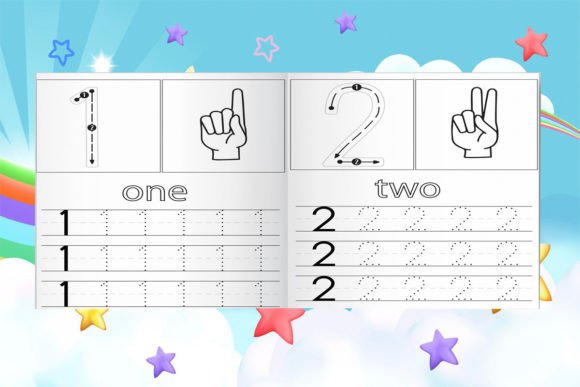
A standout feature in modern tracing pages is the inclusion of finger counting diagrams. Beside the written numeral, you might see a hand graphic with fingers folded down to represent the quantity. This is not mere decoration. It creates a direct tactile link. A child can look at the printed hand, mimic the finger position with their own hand, and then trace the corresponding digit. This three-step process—see, do physically, write—cements the concept of cardinality, the understanding that "three" represents a specific set of three items, not just a squiggly shape that comes after two.
The Joy of Color: Customization and Engagement
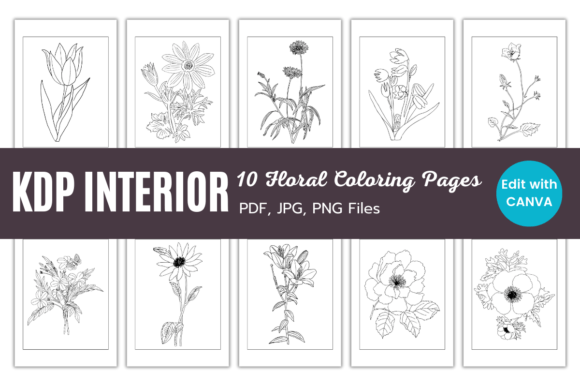
The directive to “Color the numbers” transforms a writing drill into an art project. When a child invests time in filling a traced number 8 with their favorite shade of blue, they attain a sense of ownership over that number. This emotional investment boosts retention significantly. For a KDP version, providing black-and-white line art that invites coloring is a strategic choice; it keeps printing costs low for parents while maximizing the interactive value for the child. It ensures that one page can deliver a lesson in numeracy, fine motor control, and creative expression.
Unpacking the Sequence: From 1–10 to the Teens (19 and 20)
While the journey from 1 to 10 number tracing pages establishes the core digits, the progression to larger numbers opens a new cognitive door. Many workbooks stumble when they hit the double digits. A high-quality curriculum, however, acknowledges that numbers like 19 and 20 are not merely "one and nine" or "two and zero" mashed together.
Mastering the Base Ten System
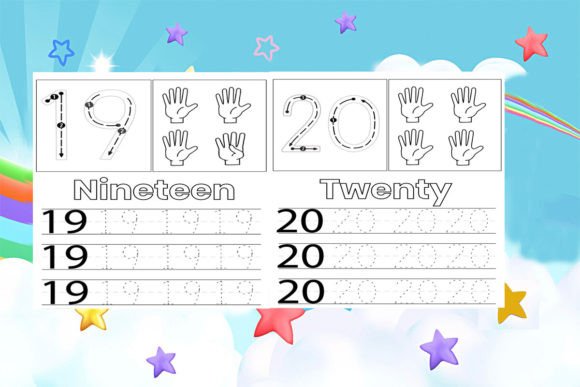
When a child traces the number 20, they are confronting place value for the first time. The "2" now sits in the tens place, representing two groups of ten items. A well-designed tracing worksheet for the upper teens does not just show dotted lines; it visually groups objects into sets of ten. You might see a bundle of ten pencils circled, and then another nine loose pencils next to it to illustrate 19. This visual grouping is critical for preventing later math anxiety. Children learn not to fear the "big numbers" because they see them as a simple pattern of tens and ones.
The "Hard-to-Reach" Numbers
It is interesting to note that the motor pattern for writing 19 and 20 is often trickier than that for lower numbers. The transition from the single stroke of the 1 to the circular 9 requires careful spacing. The 2 requires a distinct curve and a flat base, followed immediately by the oval of the 0. Explicit practice on these transitional digits using children number tracing pages 19 20 prevents the common problem of number reversals (writing 21 as 12) and cramped spacing. These pages provide an isolated, focused space to perfect the formation before a child has to write "21" on a narrow worksheet line.
Practical Applications: Home, Classroom, and Business
The utility of this tracing set extends across diverse environments. It is genuinely a multi-functional asset.
For the Homeschooling Parent
The print-ready nature of these files is a lifeline. A parent teaching a kindergartner can print the PDF weekly, focusing on one number at a time. They might use the PNG file on a tablet with a stylus for a paperless "try it" session. The repetition of tracing and coloring keeps a child productively occupied while the parent attends to an older sibling.
For the Traditional Preschool Teacher
In a bustling preschool center, these 8.5 x 11 inch sheets are perfectly sized for tabletop activities. Teachers can laminate the pages to create reusable dry-erase math centers. The finger counting graphics serve as a built-in self-check mechanism: "Trace the three, find the hand with three fingers, and color them both." This encourages independent learning and frees the teacher to provide one-on-one intervention where truly needed.
For the Amazon KDP Entrepreneur
If you are reading this as a content creator, you recognize the gold standard of a "done-for-you" interior. A package offering PDF, PNG, and AI source files is a powerful product. The AI (Adobe Illustrator) file is particularly prized because it allows you to rebrand the workbook, adjust the difficulty, translate the instructions into a different language, or bundle it with letter tracing pages to create a massive 200-page mega-tracing book. The fact that these are designed for KDP with the exact trim size and no-bleed specifications means they require zero technical wrestling with Amazon’s print guidelines—you simply upload and go. The market for kindergarten preschool learning materials is perennially evergreen on the platform.
Common Misunderstandings About Tracing
Some critics of worksheet-based learning argue that tracing is "dull" or "rote memorization." This is a misunderstanding of how these tools are intended to be used. A tracing page is not a silent babysitter. It is a scaffold. The best results come when an adult sits with the child and uses numerical language: "Curve around for the zero, just like making a big circle."
Another assumption is that once a child traces numbers 1 through 10, they are ready to write on standard ruled paper. This is rarely the case. The spatial boundaries of the 8.5 x 11 page with large, bold lettering serve as a safe zone. Transitioning to tiny paper too early can cause a regression in neatness and confidence. It is perfectly developmentally appropriate for a child to use large tracing pages for the entire kindergarten year, slowly refining their motor memory.
Maximizing the Learning Experience
To extract the full value from these pages—whether you are teaching numbers 1-10 or advancing toward 20—consider these strategies:
- Multi-sensory layering: Before picking up a crayon, have the child "trace" the number in a tray of sand or shaving cream. This pre-writes the shape in their nervous system.
- Verbal prompts: Use consistent directional language. "For the number 5: across the top, down the back, and curve a belly." These sound cues become internalized and trigger the motor plan.
- Display completed work: The Color the numbers component turns the math lesson into decor. Hang the finished, brightly colored masterpieces on the wall to confirm that math is a beautiful, celebrated part of daily life.
- Quality tools: Use short, triangular pencils or fine-tipped easy-grip markers. A child struggling with an adult-sized pencil will read the struggle as "math is hard," whereas an appropriate tool lets them focus on the shape.
The evolution from counting on fingers to writing a bold, confident 20 is a remarkable journey compressed into a few short years. By selecting high-quality, print-ready tracing materials that align with KDP standards and key educational principles, you are not just buying paper—you are engineering a brain that is comfortable with numbers. Whether you are clicking "print" for your preschooler at home or clicking "publish" on Amazon’s dashboard, the underlying goal remains the same. We are creating those quiet, magical moments where connection meets curriculum, one traceable digit at a time.