Worry Analysis Journal Page and Interior: A Practical Guide to Mental Clarity and Self-Evaluation
Worrying feels productive in the moment but often spirals into repetitive thought loops that drain energy and cloud judgment. The Worry Analysis Journal Page and Interior shifts that dynamic. It provides a structured, repeatable method for capturing anxious thoughts, examining them objectively, and converting diffuse stress into clear action. Whether you use it as a personal self-coaching tool or as a ready-made interior for a KDP publication, the value lies in its design. It is not just a blank notebook. Each page encourages the specific cognitive work that reduces the grip of worry over time.
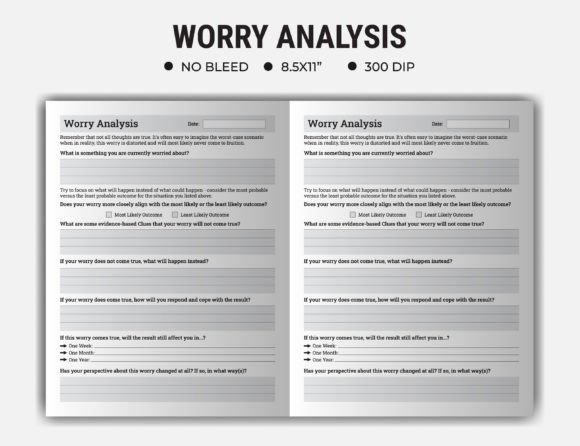
This resource, available as a printable PDF and JPG at 300 DPI, includes a full 120-page interior sized at 8.5″ × 11″ with no bleed. It is tested on Amazon KDP, so it integrates smoothly into self-publishing workflows. But beyond the technical specifications, the journal’s real power is its application in everyday mental health and productivity contexts. For professionals, creators, educators, and anyone managing a high cognitive load, the ability to interrupt anxiety and redirect focus is a practical skill — not just a therapeutic ideal.
What the Worry Analysis Journal Page and Interior Actually Contains
The Worry Analysis Journal Page and Interior is a printable self-evaluation worksheet designed around core cognitive behavioral therapy (CBT) principles. Instead of an unstructured journal, each page leads you through a sequence: identifying the specific worry, rating its intensity, listing the evidence for and against the feared outcome, challenging distorted thinking, and defining a concrete coping or problem-solving step. Over the 120-page interior, this structure repeats consistently, creating a ritual of analysis that becomes more automatic with use.
The product download includes one high-resolution JPG and one PDF, both at 300 DPI — crisp enough for professional printing or digital annotation apps. The 8.5″ × 11″ size with no bleed means the pages are ready for hole-punching, binding, or simply printing on standard letter paper. For KDP publishers, the ready-to-upload interior eliminates the guesswork around formatting, margins, and Amazon’s print specifications. But even if you never upload it to KDP, having a clean, professionally formatted PDF means you can print fresh copies whenever you need them, without layout headaches.
Where Worry Analysis Fits Into a Broader Workflow
Worry analysis is not a standalone activity to do only when you feel overwhelmed. It works best when integrated before, during, and after the moments that generate anxiety. In project management, for instance, a marketer launching a campaign can use a worry analysis page before the launch to surface unspoken fears — “What if the open rate is lower than last quarter?” — and then examine the actual data and possible responses. That process turns a vague dread into a contingency plan. During the campaign, a quick midday journal entry can recalibrate when real-time metrics trigger stress. After the campaign, an analysis page helps separate emotional reactions from actionable lessons.
Similarly, a freelancer facing a difficult client call might spend five minutes with the page beforehand. Writing down the worry (“The client will think my work is subpar”) and then listing evidence (“They have approved three milestones so far”) can dramatically reduce the emotional charge. The page acts as a pre-meeting mental warm-up, much like an athlete visualizes success. Creators who wrestle with perfectionism can use it as a “creative unblocking” tool. Instead of staring at a blank canvas, they analyze the worry (“This won’t be original enough”), challenge it, and set a tiny next step. The worksheet becomes a bridge back into action.
How the Printable Journal Interacts with Other Tools and Methods
A worry analysis page doesn’t exist in isolation. It complements digital and analog systems alike. For bullet journal enthusiasts, the 8.5″ × 11″ sheets can be folded or trimmed to fit a traveler’s notebook, or punched for a disc-bound planner. They work alongside habit trackers, mood logs, or gratitude entries to create a fuller mental health snapshot. If you use a therapy app, the page can be a tangible prelude to a session — bringing structured notes to your therapist that pinpoint exactly where you’re stuck.
For those who prefer tablet-based planning, the 300 DPI PDF imports cleanly into GoodNotes, Notability, or Xodo. Annotations stay sharp, and you can duplicate pages infinitely. This bridges the gap between high-tech and low-tech: you get the cognitive benefits of handwriting (slower processing, deeper encoding) with the convenience of cloud backup and searchable text if you later add a digital summary. In a KDP context, the interior pairs well with a separately designed cover template, and because it’s tested on Amazon, you avoid common formatting rejections — which saves hours of trial and error for self-publishers.
Implementation Tips for Daily and Long-Term Use
Getting value from the Worry Analysis Journal Page and Interior requires more than filling out a few pages. Consistency matters, but it doesn’t have to mean daily entries. Some people anchor it to a weekly review session. Every Sunday, they flip through the past week’s pages and look for patterns — recurring worries, overestimated threats, or coping strategies that worked. This transforms the journal from a crisis tool into a self-research instrument.
Preparation is straightforward. Print a batch of pages and store them in a three-ring binder. Or, if you’re using the KDP interior to create a bound workbook, you can produce a polished, sellable product that walks users through a 120-page worry management course. Either way, the no-bleed design means every page is usable without trimming. If you print at home, a heavier paper (24 lb or higher) minimizes ghosting and makes writing with fountain pens or markers pleasant.
For those new to anxiety journaling, start small. Commit to analyzing just one worry per day for two weeks. Set a timer for 10 minutes. The structure prevents over-rumination because it forces you to reach a resolution — either an action step or an acceptance statement. Over time, you’ll notice that the initial intensity rating you assign often drops by the end of the entry, which is a tangible metric of emotional regulation.
Quality Control and Usability Considerations
Because this interior is 300 DPI high resolution, the text and lines remain crisp even when scaled. This is essential for older adults or anyone with visual fatigue — the clarity reduces strain during longer journaling sessions. The 8.5″ × 11″ size provides ample writing room without feeling cramped, which is a common complaint with smaller journals. There’s enough space to write multiple sentences for each prompt, encouraging thorough processing.
From a usability standpoint, the no-bleed layout matters for home printing and for KDP. Bleeds can shift cutting margins and waste paper; here, everything stays safely within the trim area. For KDP uploads, the file is already optimized, so you don’t need to fiddle with margins or gutters. The testing on Amazon KDP means the file passes automation checks, and the interior’s consistent formatting ensures a professional look page after page. If you’re selling the journal, that reliability protects your ratings and reduces returns due to printing errors.
Integrating the Page Into a Broader Mental Health Therapy Framework
Therapists often recommend thought records or worry logs between sessions. The Worry Analysis Stress Journal Page serves exactly that function but in a cleaner, more user-friendly format than photocopied handouts. It includes prompts for self-evaluation, anxiety rating, cognitive distortions, and coping strategies — all elements of standard CBT and anxiety management protocols. A therapist can review the pages with a client, spotting themes that might not surface in conversation alone. Over 120 pages, that data builds a rich narrative of progress.
For individuals not in formal therapy, the journal still functions as a self-led intervention. By forcing you to write down worries and then systematically dismantle them, it interrupts the amygdala’s alarm loop and engages the prefrontal cortex. This is not pop psychology; the process mirrors techniques used in structured problem-solving and exposure therapy. The journal becomes a form of deliberate mental rehearsal, and when used consistently, it can reduce the habit of catastrophic thinking.
Organizing the Interior for Different Use Cases
There is no single right way to sequence the 120-page interior. Some users prefer to fill pages sequentially, creating a chronology of their worries. Others split the pages into themed sections: work stress, health anxiety, relationships, financial concerns. Since the PDF is printable, you can physically divide the sheets with tab dividers. If you’re a KDP publisher, you might add an index or instructional front matter before the interior pages to guide your buyers. The interior’s flexibility supports this: you can insert a custom title page or reflection prompts without breaking the flow of the worry analysis worksheets.
Digital users can duplicate the JPG or PDF pages in their app and tag entries with keywords like “urgent,” “recurring,” or “resolved.” This creates a searchable worry database. Over months, reviewing resolved worries builds self-efficacy — you have concrete proof that problems you once feared were manageable. This archive becomes a personal resilience reference, especially useful during periods of high stress when perspective narrows.
Long-Term Value and the Role of Consistency
Any tool’s effectiveness depends on sustained engagement. The 120-page count is deliberate. It’s enough to last three to four months of daily entries or a full year of weekly ones. That duration aligns with the time needed to establish new cognitive habits. By the time you finish the interior, the process of analyzing worries — rather than swallowing them — will likely feel more natural. The journal’s repetitive structure trains you to instinctively ask, “What’s the evidence?” when anxiety spikes, even without the page in front of you.
For professionals, this skill translates directly into better decision-making. A small business owner evaluating a risky expansion can apply the same evidence-weighing technique from the journal to a spreadsheet analysis. A blogger facing a wave of imposter syndrome can quickly identify the cognitive distortion (probably “mind reading” or “fortune telling”) and refocus on the next piece of content. The journal’s real product is not the ink on the page; it’s the internalized mental framework that persists long after the 120 pages are filled.
Practical Workflow Example: The Anxious Project Lead
Consider a project lead at a mid-sized agency preparing for a major client pitch. The night before, her mind runs through worst-case scenarios. She opens her worry analysis journal and writes:
Worry: “Our proposal will be rejected because we missed a key feature.”
Intensity (1-10): 8
Evidence for: The client mentioned that feature once in a previous email. We haven’t included a detailed timeline for it.
Evidence against: We included three alternative feature strategies. Our main proposal addressed their top three pain points. The feature they mentioned was aspirational, not core.
Cognitive distortion: Catastrophizing, mental filtering.
Action: Prepare a one-page addendum outlining how we’d approach that feature if they bring it up. Note it in the presentation appendix.
Intensity after re-evaluation drops to 3. The worry is defused, and the action step is practical. In the meeting, the client doesn’t even raise the feature, but the lead feels prepared and clear-headed. This is the workflow in action: the journal page acted as a pre-mortem tool, not just a stress reliever.
Making the Most of the Ready-to-Upload KDP Interior
If you’re a self-publisher, the KDP-ready format eliminates formatting pain. The interior is pre-tested on Amazon KDP, meaning trim size, margins, and bleed settings have already been validated. You can focus on designing a compelling cover and writing a strong product description. Since the content is generic and undated, it works year-round without needing updates. Niche down: brand it for new mothers, graduate students, or corporate professionals. The pages remain the same, but the framing changes the audience’s perception.
After downloading the JPG and PDF, verify the print quality with a single-page test. Check for any font embedding issues (though generally none exist). The high resolution ensures that even fine lines appear sharp. For a premium product, consider including a short guide or video QR code that helps buyers understand how to use the pages. That additional layer of value can differentiate your listing in a crowded self-help journal category.
Adapting the Printable for Personal and Professional Growth
Beyond anxiety management, the Worry Analysis Journal Page and Interior can function as a decision-quality audit tool. Before a significant purchase or career move, use a page to deconstruct the fear-based part of your thinking. This often reveals hidden assumptions — “If I leave this job, I’ll never find another” — that don’t hold up under scrutiny. Coupled with a traditional pros-and-cons list, the worry analysis adds emotional intelligence to rational planning. For educators, the structured format can be adapted for student self-reflection exercises, teaching metacognition alongside content. The PDF can be printed as needed, making it a cost-effective classroom resource.
In a world that equates busyness with importance, taking 10 minutes to analyze a worry can feel countercultural. But the payoff is real: fewer cognitive resources hijacked by background anxiety, more mental bandwidth for creative and strategic work. The Worry Analysis Stress Journal Page bridges the gap between knowing you should manage stress and actually having a repeatable method to do it. Whether you print a single copy for yourself or upload the interior for hundreds of readers, this tool supports a process of systematic self-evaluation that leads to calmer, clearer decisions.