100 Easy HASHI Bridge Puzzles 13 of 25
Hashi bridge puzzles, sometimes called Hashiwokakero, have carved out a loyal following among logic puzzle fans who appreciate their simple rules yet surprisingly deep deduction. They present a grid of numbered islands that must be connected by bridges following a few straightforward constraints: bridges run only horizontally or vertically, no more than two bridges can link any pair of islands, and the final layout must allow travel from any island to any other. That blend of clarity and challenge makes them ideal for puzzle books, brain-training apps, and educational materials. The 100 Easy HASHI Bridge Puzzles 13 of 25 collection takes that core appeal and packages it in a way that saves creators hours of design and testing work while offering solvers a satisfying, frustration-free experience.
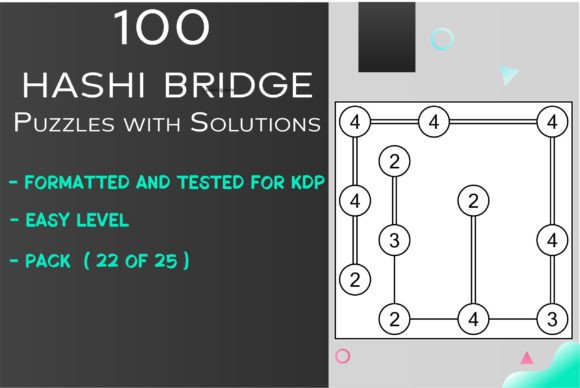
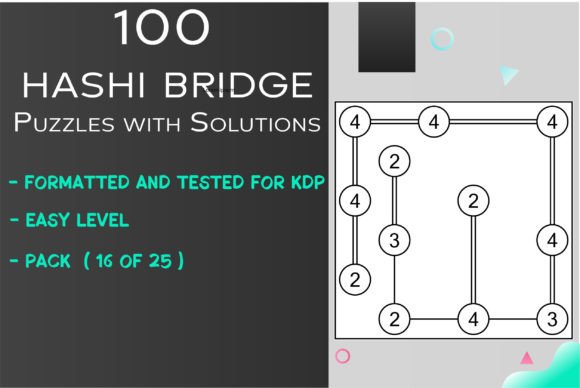
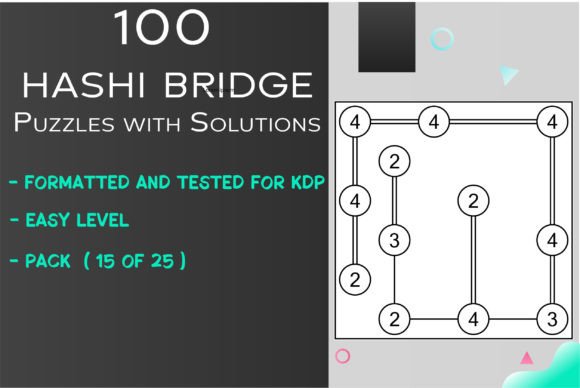
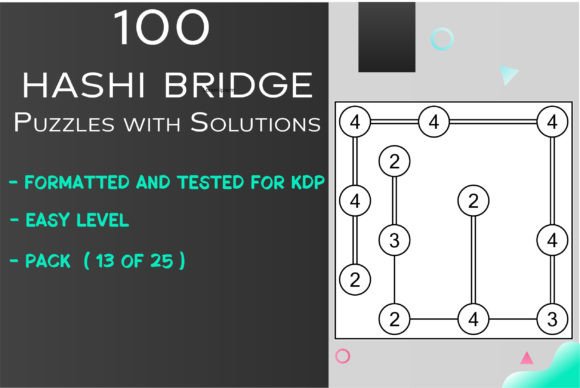
This particular set includes exactly one hundred puzzles, all built on a compact 6x6 grid and rated as easy. It also comes with complete solutions for every puzzle. The term “13 of 25” indicates its position in a broader series, hinting at a well-organized catalog that lets publishers build a consistent line of puzzle books without worrying about duplication or erratic difficulty spikes. Whether you're putting together your first KDP puzzle book or looking to expand an existing series, the structure behind this release helps maintain steady quality across volumes.
What Makes a Hashi Puzzle Collection Stand Out
Not all puzzle compilations are equal. The difference often lies in how carefully the grids are tested, how cleanly the answer keys are prepared, and whether the file formats mesh with the software you already use. 100 Easy HASHI Bridge Puzzles 13 of 25 arrives in four formats—EPS, PNG, JPG, and SVG. That matters more than it might seem at first glance. EPS and SVG give you fully scalable vector graphics you can resize for any page dimension without losing sharpness. PNG and JPG provide quick raster options for previews, online mockups, or straightforward importing into less specialized programs. Having all four means you are never forced to convert files awkwardly or compromise print quality.
Each puzzle sits on a 6x6 grid, a deliberate choice for an “easy” label. That size keeps the solving time manageable—typically a few minutes per puzzle—while still requiring enough logic to feel rewarding. Solvers can complete one or two during a coffee break, which suits the casual puzzle consumer perfectly. For publishers, the compact grid also translates to clean, uncluttered page layouts that work well on 6x9 or 8.5x11 inch pages, the standard trim sizes for many puzzle books.
Practical Value for KDP Publishers
If you publish print-on-demand puzzle books through Amazon KDP, you already know that content creation is only half the battle. Formatting, alignment, bleed settings, and solution placement consume enormous time. A ready-made puzzle collection steps in as a reliable shortcuts without sacrificing a custom feel. When you download 100 Easy HASHI Bridge Puzzles 13 of 25, you get puzzles that have been tested for logical uniqueness—meaning each has exactly one correct solution—so you avoid the embarrassment of publishing a book with flawed puzzles that frustrate buyers and trigger negative reviews.
Here are several ways KDP publishers commonly put such a set to work:
- Complete puzzle book interiors. Combine several volumes from the same series to fill a 100-page or 200-page book with a gradual difficulty curve.
- Sample puzzles for “Look Inside” previews. Pick a handful of puzzles to display on Amazon’s preview feature, giving potential customers a taste of the solving style.
- Bonus content. Add a few puzzles at the back of a different genre book, such as a crossword or Sudoku compilation, to introduce variety and increase perceived value.
- Digital downloads. Use the PNG or JPG files to create printable PDFs sold through Etsy or your own website, expanding revenue streams beyond KDP.
Another subtle advantage is consistency. When you build a puzzle brand, readers start to recognize your layout choices, font styles, and answer key format. 100 Easy HASHI Bridge Puzzles 13 of 25 provides a uniform starting point. Since the files are unflattened where possible, you can tweak line weights, island colors, and number fonts before finalizing your book’s interior. A designer can open the SVG in a vector editing program, adjust the visual style to match a brand palette, and output a completely fresh look while keeping the underlying puzzle logic intact.
Beyond Publishing: Other Real-World Applications
While KDP publishers are the most obvious audience, the collection slides neatly into several other environments. Teachers and tutors may use these easy Hashi puzzles as warm-up exercises that strengthen logical reasoning and pattern recognition without taking up a whole class period. Because the rules are intuitive even for younger learners, a 6x6 grid becomes a gentle introduction to constraint-based thinking. The solution files make it simple for an instructor to verify student work quickly.
Corporate training facilitators sometimes incorporate logic puzzles into team-building sessions. A printed Hashi sheet works as a low-pressure icebreaker that encourages collaboration. The easy difficulty means groups can solve the puzzle without feeling stuck, which supports a positive atmosphere. The EPS and SVG formats allow companies to resize the puzzles for large-format handouts or even projection onto screens.
Hobbyists who run puzzle blogs or social media channels also find value in ready-made puzzle packs. Instead of building every puzzle from scratch with dedicated software, they can drop a PNG into a post, add their own commentary or solution walkthroughs, and keep a regular publishing schedule. The consistent quality helps maintain audience trust. A blogger might use a puzzle from 100 Easy HASHI Bridge Puzzles 13 of 25 as a weekly feature, linking back to a larger collection or simply offering a standalone mental break for readers.
For individuals who simply enjoy solving puzzles for relaxation or mental stimulation, the printed answer pages add a layer of convenience. No more second-guessing whether you made a mistake; you can check your work and move on. Easy Hashi puzzles are often used during commutes, lunch breaks, or quiet evenings as a screen-free way to unwind. The 6x6 grid size keeps the activity light and portable, and the hundred-puzzle count guarantees many sessions of entertainment.
Customization and Creative Control
A frequent concern with pre-made puzzle content is that it might lock you into a specific visual style that clashes with your brand. With vector formats like SVG and EPS, that concern evaporates. You can isolate the bridge lines, adjust their thickness, swap colors, and even redesign the island shapes if you have basic vector editing skills. Want the puzzles to look like they belong in a vintage newspaper? Apply a sepia tone and a slightly distressed typeface for the numbers. Prefer a modern, clean aesthetic? Thin, uniform lines and a sans-serif font on the islands achieve that instantly.
The solutions can be integrated into the main puzzle page or placed at the end of the book, depending on your reader demographic. Some audiences prefer solutions right after the puzzle for instant feedback, while others enjoy a dedicated answer section at the back of the book. Because you receive separate puzzle and solution files, you can arrange them to suit the reading flow you envision. There is no forced structure.
One practical tip: when preparing files for KDP, always embed or outline fonts on the islands if you edit them in SVG. This prevents any font substitution issues during the printing process. Even if you do not plan to edit the text, opening the SVG and saving it as a print-ready PDF often yields better rasterization control than using the PNG directly within a word processor.
What to Look for When Choosing a Puzzle Set
The market has no shortage of puzzle collections, so it helps to know what distinguishes a well-produced set from a careless one. Here are a few points to weigh:
- Tested uniqueness. Every puzzle should have one and only one solution. Sets that skip this step risk confusing users and damaging your credibility.
- Appropriate difficulty labeling. A 6x6 grid labeled “easy” should feel genuinely approachable. Inconsistent difficulty ratings frustrate buyers who expect a certain level of challenge.
- Vector file availability. Raster files like PNG and JPG are convenient, but vectors give you the freedom to scale without quality loss. For print, that is non-negotiable for professional results.
- Clear solutions. Answer keys should be unambiguous, with bridges drawn in a way that leaves no room for misinterpretation. Some sets include line counts on bridges, which is a nice touch for clarity.
- Commercial use rights. If you intend to publish, ensure the license allows commercial distribution within puzzle books. The described collection is tailored for KDP, so that permission is already baked in.
Considering these factors, 100 Easy HASHI Bridge Puzzles 13 of 25 aligns well with the needs of a publisher who values reliability and design flexibility. The compact file size means you download the whole package without lengthy waits or storage concerns, and the high-resolution graphics deliver clean prints even at larger page sizes.
Integrating E-E-A-T Principles in Your Puzzle Products
Google’s emphasis on experience, expertise, authoritativeness, and trustworthiness extends to the content you publish, even puzzle books. When you use a vetted puzzle collection, you demonstrate a commitment to accuracy (every puzzle works) and user experience (no broken or unsolvable grids). Readers notice that care. They also appreciate when solutions are easy to follow and the layout does not feel cramped.
Adding a short introduction page that explains Hashi rules in simple language further builds trust, especially for beginners. Since the puzzles in this set are easy, your book might attract first-time solvers. A well-written rule overview, paired with a small example, lowers the barrier. You can craft that supplemental content yourself, using the puzzle files as the core offering.
Another trust-building tactic is to vary puzzle types within a single book, but you want each section to come from a reputable source. Using collections from a consistent series, like the “13 of 25” designation implies, signals that someone curated the experience thoughtfully. It prevents the thrown-together feel some multi-puzzle compilations suffer from.
Making the Most of the 100-Puzzle Format
One hundred puzzles give you flexibility. You could split them into chapters of 20 or 25, each with a short introduction or tip. Some publishers add motivational quotes, small illustrations, or progress trackers to strengthen reader engagement. Because the puzzles are easy, you might position the book as a “quick daily brain break” and number the puzzles by day. The simple grid size supports a fast turnaround for the solver, which encourages daily use.
You might also consider bundling this collection with other numbers in the same series to create a gradual progression. For example, combine this easy set 13 of 25 with a medium-difficulty set and a hard set from the same series. The result is a complete Hashi journey that appeals to a wide spectrum of solvers and can command a higher page count and list price on KDP.
Whether you are a seasoned KDP publisher, a teacher looking for classroom materials, or a casual solver who wants a stash of puzzles ready to print, 100 Easy HASHI Bridge Puzzles 13 of 25 offers a practical, professionally assembled resource. The careful format selection, tested puzzle integrity, and easy difficulty level combine to serve a variety of real-world needs without unnecessary complexity.