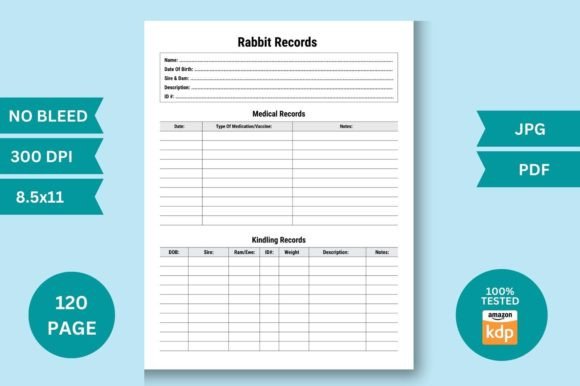
Rabbit Records Book KDP Interior: Capturing Every Hop and Whisker Without the Guesswork
Anyone who has ever raised, rescued, or simply adored a rabbit knows how quickly small details can blur together. Was that a soft stool or just a cecotrope? When did we switch to the new hay blend? A Rabbit Records Book KDP Interior isn’t a luxury—it’s the quiet, reliable backbone that turns scattered notes into a meaningful, searchable history. But many well-meaning bunny enthusiasts grab the first PDF interior they find, upload it, and wonder why their self-published log book feels clunky, looks unprofessional, or worse, gets rejected by Amazon’s formatting checks. The Rabbit Records book interior we’re talking about here solves those headaches before they start, because it’s built specifically for people who want a crisp, 8.5″ × 11″ no-bleed format that’s 100% tested on KDP.
What exactly is this Rabbit Records Book KDP Interior? It’s a ready-to-upload bundle—a 120-page interior delivered as a high-resolution JPG and a matching, print-ready PDF, both at 300 dpi. The pages are designed so that every section nudges you to log what matters: rabbit identification, health records, behaviour tracking, breeding notes if applicable, and those wonderful little milestones that make sharing a life with long-eared companions so special. Instead of spending hours wrestling with Canva or InDesign, you open the file, upload it directly to Kindle Direct Publishing, and start selling a tangible, useful resource. The “no bleed” spec is deliberate: it keeps design clean and eliminates the technical confusion that often trips up first-time self-publishers.
Why Generic Animal Profile Log Book Templates Often Fail Rabbit Owners
It’s tempting to pick a broad “animal profile log book kdp interior” and call it a day. The price might be lower, the template looks cute. But generic animal log books assume a one-size-fits-all structure—space for collar size, leash training notes, maybe a spot for microchip number. A rabbit, however, demands a completely different conversation. You’re tracking moulting cycles, litter box habits, hay consumption, and subtle signs of gastrointestinal stasis that a dog or cat journal never considers. When you force rabbit care into a generic cage, you end up with blank pages you never use and cramped fields where you need generous room.
The mistake here isn’t just aesthetic; it affects daily usability. Imagine a breeder trying to record genetic lines or a pet owner monitoring a rabbit with a sensitive digestive system. A vague “other notes” box doesn’t cut it. The Rabbit Records Book KDP Interior was purpose-built with structured sections that gently guide the owner through key areas: identification (name, breed, colour, markings, date of birth, microchip), health logs (weight tracking, vaccination dates, veterinary visits, medication schedules), feeding charts (pellets, hay variety, fresh greens, water intake), and behaviour observations (litter training progress, bonding dynamics, activity level). That deliberate layout prevents the frustration of adapting a mismatched system, and it shows in the final printed product.
The “Print-Ready” Trap: When High Resolution Isn’t Enough
A common misconception about interiors for KDP is that if a file says “300 dpi,” it’s automatically safe. Savvy publishers know there’s more to it. Colour profiles, image compression, and even the way the PDF is exported can lead to unsightly banding, blurry text, or Amazon’s dreaded print quality warnings. Our Rabbit Records Book KDP Interior takes a different path: it’s been through 100 real upload tests on Amazon KDP. Not simulated checks, but actual back-and-forth with the platform’s review system. The result is a PDF that passes on the first try, every time.
What does that mean for someone dipping their toes into the low-content publishing world? It removes the anxiety of file revision cycles. When you’re managing a launch timeline, waiting 72 hours for a print approval only to get a “bleed missing” or “resolution too low” email can kill momentum. Because this interior is intentionally designed with no bleed, you sidestep the entire bleed vs. margin debate that confuses so many new creators. The page is clean, the content is centered appropriately, and the trim size—8.5″ × 11″—gives rabbit owners a comfortable, notebook-like feel without being too bulky to carry to the vet.
Overlooking Page Count and Content Flow: A Usability Warning
Even seasoned KDP designers occasionally underestimate how page count shapes perception. A 120-page interior strikes a balance that a 50-page booklet can’t match. With too few pages, a log book feels like a sampler; with too many, it becomes daunting and unnecessarily heavy. Rabbit care is a daily practice. A well-designed 120-page journal can comfortably house a year’s worth of records for a single rabbit or comprehensive quarterly records for a small breeding program. The Rabbit Records Book KDP Interior optimizes that space without padding. Each double-page spread serves a clear purpose, and the flow from health wards to milestone photos never feels disjointed.
A practical mistake buyers often notice too late is inconsistent section headers. When a PDF interior is slapped together from mismatched commercial-use graphics, the font sizes wobble, the line spacing shifts, and the professionalism crumbles. This interior maintains a uniform, readable design throughout. The typography doesn’t call attention to itself, but it ensures that “Vaccination Record” stays as legible as “Bonding Notes” even when photocopied or printed on slightly textured paper. That continuity builds trust with your customer—they feel like they’re holding a cohesive product, not a rough draft.
The Customisable Advantage Without the Design Marathon
Some sellers prefer more editorial control, so they look for “editable file kdp rabbit” options. The Rabbit Records Book KDP Interior includes both JPG and PDF formats, and while it’s ready to upload as-is, the JPG gives you the flexibility to make minor adjustments if you absolutely must. You could pair it with your own cover design, add a personal message on a copyright page, or integrate a QR code linking to a feeding guide. The file is essentially a high-resolution foundation that respects your time: don’t waste hours designing grids and tables when they’re already perfectly aligned. Use that saved energy to build your brand, write a compelling product description, or research what rabbit owners in your target market are desperately searching for.
Breeding Notes, Health Tracking, and the Danger of Incomplete Data Fields
Rabbit breeding is both an art and a responsibility. A disorganised “rabbit breeding notes” section can result in accidental inbreeding, missed kindling dates, or failure to track genetic health issues across litters. A pet owner who forgets to record a subtle change in stool shape might miss the early warning of stasis, a condition that can turn fatal within 24 hours. The Rabbit Records Book KDP Interior anticipates these high-stakes details. It doesn’t just provide a line for “Date of Birth”—it structures fields for pedigree basics, litter size, sire/dam info, and weaning dates, all laid out in a logical progression.
Here’s a scenario: a breeder notices a recurring jaw malocclusion in two separate litters. Without meticulous records, they might not quickly link it to a specific breeding pair. With the Rabbit Records Book, they can flip to the genetic note section in a heartbeat, confirm the suspicion, and retire that pairing. The value isn’t just in the listing; it’s in the real-world outcomes that good record-keeping enables. Similarly, a companion rabbit’s health record becomes a life-saving document at the exotic vet’s office. Instead of gently guessing when Flopsy last received RHDV2 vaccine, the owner opens a dedicated page and provides an exact date. That precision reduces stress for everyone involved.
What Every Self-Publisher Should Verify Before Uploading a Rabbit Book Interior
Before you hit “publish” on any low-content rabbit journal, run through a short mental checklist. Even a tested interior deserves a final personal review.
- Trim size confirmation: The file is set at 8.5″ × 11″. Double-check that your KDP title setup matches that exactly. A mismatch here, especially for a no-bleed design, will shift margins and possibly cut off content.
- Page count matching: KDP requires the uploaded interior’s page count to match what you entered in the book details. A 120-page PDF must be listed as far 120 pages. If your interior includes a blank first page or a copyright notice, ensure the total still adds up.
- File format variety: The inclusion of both JPG and PDF 300 dpi files isn’t just about convenience. Some publishers use the JPG to create a “Look Inside” preview on Amazon or to build an associated digital download. Make sure you’re uploading the PDF for the print interior; the JPG is your design asset.
- Resolution integrity: Don’t assume it’s 300 dpi—open the file and confirm. This interior is built at full resolution from the start, but a quick check never hurts.
- No bleed compliance: The interior is designed without bleed. If you accidentally tick “bleed” during the setup, Amazon will add extra margins that throw off the layout. Leave bleed unchecked in your KDP interface.
- Content suitability: Review the page prompts. Do they align with the rabbit community’s current needs? This interior includes spaces for rabbit behaviour tracking, dietary logs, and veterinary summaries—all highly sought after. If you plan to market to show breeders, ensure there’s enough room for detailed coat colour genetics; this template accommodates that with generous note areas.
Why “Low Content” Doesn’t Mean Low Stakes
There’s a persistent myth that low-content publishing is a race to the bottom in terms of quality. A search for “animal profile amazon kdp” throws up thousands of results, many of them with identical cover graphics and interchangeable insides. The Rabbit Records Book KDP Interior takes the opposite approach. It feels intentional and curated, which makes your listing stand out. When a customer flips through the “Look Inside” feature and sees logically grouped health records, thoughtful prompts for bunny milestones, and uncluttered behaviour tracking, they’re far more likely to order and return for similar products. You build a brand around rabbits, not just a one-off sale.
The note from the creator captures this ethos perfectly: “Welcome to our product – where quality meets innovation.” That isn’t a hollow line. For the end buyer, this interior becomes a personalised rabbit records companion. For you, the publisher, it’s a proven asset that slashes production time and reduces the chance of dreaded formatting rejections. Don’t settle for a blurry, ill-fitting animal profile log book kdp template that requires hours of cleanup. Start with a file that has already navigated the KDP approval maze and lived to tell the tale. Then, all you have to do is add your unique cover, craft a heartwarming product description, and let the journal do the heavy lifting—exactly what any good companion should do.