Social Work CE Log and KDP Interior: A Practical Tracker for Professionals
Social workers carry a heavy load. Between case management, advocacy, community engagement, and direct client care, staying on top of continuing education (CE) requirements often becomes a last-minute scramble. The Social Work CE Log and Kdp Interior addresses that gap directly. It’s a ready-to-use record-keeping book built specifically for licensed social workers who need a reliable way to document workshops, trainings, and courses—and it doubles as a polished, print-ready KDP interior for those who publish low-content books. This simple tool merges organized planning with the sharp design standards Amazon expects.
Why a Dedicated CE Tracker Matters in Social Work
Every state licensing board has its own compliance rules, but one requirement remains constant: you must prove you’ve earned the required continuing education hours. Without a structured system, paper certificates pile up, digital confirmation emails get buried, and renewal season turns into an anxious hunt. A Social Work CE Log takes the chaos out of the equation. Instead of relying on scattered spreadsheets or sticky notes, you have one place to capture course titles, dates, provider names, contact hours, and even learning reflections.
For social workers moving between roles—clinical practice, school-based support, policy development, or geriatric care—the logbook becomes a portable professional record. It’s more than compliance; it’s a way to track your growth, notice patterns in skill development, and identify areas where additional training could expand your impact. You might log a trauma-informed care seminar, then a session on ethical decision-making, and over time see how both shaped your approach to advocacy work. That kind of insight rarely emerges from a checkbox task list.
What Makes This KDP Interior Stand Out
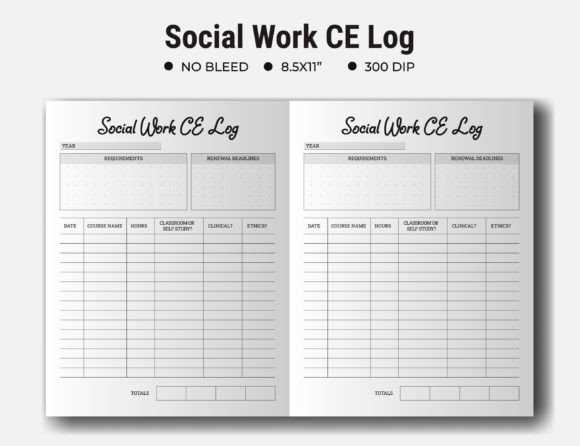
On the publishing side, designing a low-content book that resonates with buyers requires balancing function and clean layout. The KDP Interior for this logbook delivers exactly that. At 8.5″ × 11″ with no bleed, it fits perfectly into the standard Amazon print template. The 120-page count provides ample room for tracking multiple renewal cycles without feeling bulky. High-resolution pages ensure text and tables stay crisp, and because it’s tested on Amazon KDP, upload issues are minimal—no shifting margins or misaligned fields.
The interior design isn’t just empty lined pages. It’s structured with dedicated spaces for each entry: course name, provider, date, CE hours, type of activity, and a notes section. This level of detail supports accurate self-reporting and makes the logbook equally useful for LCSW, LMSW, and BSW professionals. When you open the printed book, the consistent, clutter-free layout creates a sense of calm, not another form to dread.
How Social Workers Actually Use It Day to Day
Picture this scenario: A hospital-based social worker attends a quarterly ethics training, completes an online module on cultural humility, and leads a community workshop on mental health first aid—all within two months. Each activity gets its own row in the Social Work CE Log. By the time the licensing board requests documentation, the social worker can flip to the right page and find entries in chronological order, plus any printed certificates slipped into a companion binder or pasted into the book itself. No frantic searching.
Another practical use comes from supervisors and mentors. A clinical supervisor might gift this logbook to new graduates, framing it as a career-long habit. As those early professionals move through roles in child welfare, substance use treatment, or policy advocacy, the growing record tells a clear story of their commitment to lifelong learning. Some even use the notes column to jot down takeaways that later influence their case management strategies or community engagement efforts. That turns a simple tracker into a professional development asset.
Skill Enhancement and Reflective Practice
Continuing education isn’t just about clocking hours. It’s where practitioners sharpen critical thinking, learn new intervention models, and stay informed about legal and ethical shifts. A well-maintained logbook supports that deeper work. When you review your entries before a supervision session or an annual self-evaluation, patterns emerge. Maybe you’ve consistently pursued training around trauma-informed care but have gaps in macro-level advocacy. The Social Work CE Log makes those gaps visible so you can intentionally seek out the right upcoming opportunities, rather than just grabbing whatever webinar is available.
From Low Content Product to Professional Tool
For creators and publishers, low-content books make up a significant segment of the KDP marketplace. But generic notebooks blend together. What sets the KDP Interior for this log apart is its specific, practical targeting. Social workers actively search for continuing education trackers, and a product that understands their vocabulary—CE hours, provider number, license renewal date—immediately builds trust. The interior design includes those fields without overcomplicating the page. Every line item has enough width to write comfortably, and the font choices (embedded in the PDF) stay readable after printing, even on cream paper options.
Getting the KDP details right saves hours of troubleshooting. This interior comes as a ready-to-upload PDF at 300 dpi, already formatted for 8.5 × 11 inches with no bleed. The page count is set so the spine won’t break awkwardly, and the table of contents and section headers provide gentle organization without demanding heavy design work from the publisher. For someone managing multiple low-content titles, purchasing a tested KDP planner or logbook interior like this one removes the guesswork from interior design entirely.
Making It Your Own Without Breaking the Rules
Some publishers like to add a branded cover, an introduction page, or a sample entry for clarity. Since the file is provided as both PDF and JPG, you can easily make minor adjustments in Canva or Adobe tools before uploading to KDP. The underlying template remains solid, so you aren’t starting from a blank screen. This flexibility means you can position the book for niche audiences—hospital social workers, school social workers, mental health clinicians—while keeping the core tracking functionality intact.
Why the Right Structure Matters for Usability
A CE log that’s hard to use gets abandoned. That’s why this product avoids tiny lines that barely fit a date and oversized decorative elements that steal space. The layout uses clear, separated sections: a personal information page, an annual summary sheet, and then the main log entries. Each spread handles two entries, keeping the book open flat on a desk without cracking the spine. The usability factor is high because the design stays out of your way. When a social worker is exhausted after a full day of sessions, recording a CE activity should take thirty seconds, not a puzzle-solving exercise.
For those switching between digital and physical tracking, some even scan the completed pages once a year and save them in cloud storage as a backup. The straightforward, no-bleed format means full pages scan cleanly without dark edges cutting off content. That might seem like a minor detail, but for someone who needs to send documentation to a supervisor or board, a clear scan can be the difference between an approved renewal and a delayed one.
Realistic Examples Across Practice Settings
- School social worker: Logs a district-provided restraint and seclusion training, a self-paced suicide prevention course, and attendance at a statewide conference on attendance interventions.
- Clinical therapist in private practice: Tracks ethics workshops, EMDR certification hours, and peer consultation group meetings that count toward CE requirements.
- Community organizer and macro practitioner: Documents grant-writing seminars, policy advocacy summits, and training on fair housing law—each one contributing to a more robust advocacy toolkit.
- Agency supervisor: Uses the logbook not only for personal CE but also to record in-service trainings delivered to staff, creating a ready reference during program audits.
In every case, the logbook moves beyond a simple archival function and into day-to-day case management reflection. A note next to a training entry might read, “Plan to integrate motivational interviewing prompts into next team meeting.” That kind of practical connection elevates continuing education from a regulatory hurdle to an integrated part of professional identity.
Tips for Selecting and Using This KDP Logbook
If you’re a social worker browsing options on Amazon, look for clear preview images that show the interior layout—not just a pretty cover. You want to see where the hours go, whether there’s room for a note, and how the pages handle long course titles. A well-designed social work continuing education tracker will avoid cramming too many rows onto one page. The 8.5 × 11 size with 120 pages hits a sweet spot: large enough to write comfortably, slim enough to carry to conferences or keep on a shelf without hogging space.
For publishers, the investment in a tested KDP interior pays off in reduced returns and better reviews. Buyers of low-content books are quick to criticize confusing layouts or cut-off text. When you offer a product that’s already been confirmed print-ready on Amazon, you’re ahead of many competitors. Consider highlighting in your product description that the interior was purpose-built for social work CE—mentioning the inclusion of provider fields and annual summaries—to show you understand the unique language of the profession.
How This Logbook Supports Broader Community Engagement and Advocacy
Often, continuing education opens doors to volunteer roles, board memberships, and community partnerships. When a social worker attends a training on housing rights, they might later connect a client to a legal aid clinic or start a tenant education group. Recording that training in a logbook keeps the resource fresh in memory. Over months and years, the book becomes a map of evolving expertise, one that directly feeds advocacy work. The act of writing things down reinforces learning and makes it easier to recall a key statistic or practice model during a critical moment with a client or during a coalition meeting.
This isn’t just a compliance tool—it’s a quiet partner in professional growth, whether you’re building skills for clinical licensure or deepening your capacity for system-level change. Pairing a thoughtful interior design with the specific demands of social work makes this log more useful than a generic journal or planner.
Bringing It All Together
The combination of a targeted Social Work CE Log and a reliably formatted KDP interior solves two problems at once. For the social worker, it’s a clean, organized way to track every CE activity, reflect on learning, and breeze through license renewal. For the publisher or creative, it’s a market-ready product that respects the end user’s real-world needs—something that shows up when customers search for a logbook they actually want to keep using.
Whether you’re managing a caseload or managing a KDP storefront, the value lies in simplicity done right. The pages are blank enough to adapt to any state requirement, structured enough to keep you consistent. When a tool reduces friction, it stops being a chore and starts becoming a habit—and that’s where lasting professional development takes root.