A Complete Guide to Party Supply Contracts, Rental Agreements, and Event Documentation
When planning any event—be it a wedding, corporate gala, birthday bash, or community festival—the last thing you want to worry about is a misunderstanding with a vendor. A misplaced piece of equipment, a last‑minute cancellation, or an unclear refund policy can turn a celebration into a legal headache. That’s where party supply contracts, supply agreements, and rental forms come in. These documents aren’t just paperwork; they’re the foundation of a smooth, stress‑free event. In this guide, you’ll learn what each type of agreement does, why it matters, and how to use a template to protect everyone involved—without needing a law degree.
Why Written Agreements Matter for Any Event
Whether you’re renting a single chocolate fountain or ordering thirty tables for a trade show, a handshake is no longer enough. A written party supply contract or event supply contract spells out exactly what each party is promising. It confirms who provides what, by when, and at what cost. It also sets boundaries—what happens if something breaks, who handles delivery, and how disputes will be resolved. For the host, a clear agreement means peace of mind. For the supplier, it means getting paid on time and having your equipment returned in good condition. A well‑structured supply agreement turns a verbal “I’ll bring what you need” into a legally binding promise that protects both sides.
Breaking Down the Different Types of Event Contracts
Not all event paperwork is the same. The terms you use reflect the nature of the transaction. While many people use the phrase “party supply contract” broadly, there are subtle but important differences between a rental agreement, a purchase contract, and a venue‑focused form. Understanding these will help you choose the right document every time.
1. The Party Supply Rental Contract
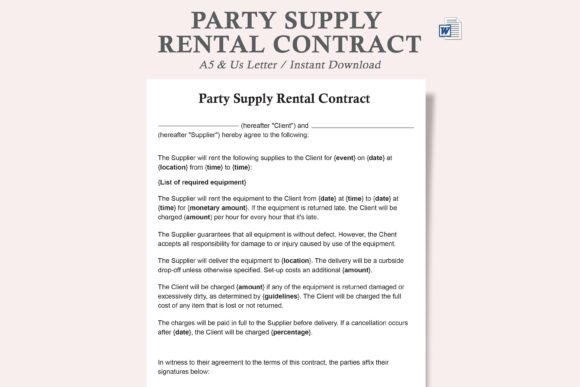
Imagine you’re hosting a backyard barbecue and need to rent tents, chairs, and a cotton‑candy machine. A party supply rental contract (sometimes called a party equipment contract or party supply rental contract) is designed exactly for this situation. It lists every item you’re renting, the rental period (often with set‑up and pick‑up times), and the cost per item or package. It also includes crucial clauses about damage waivers, cleaning fees, and late‑return penalties. Because the items are coming back to the supplier, the document usually states that you, the renter, are responsible for any loss or damage beyond ordinary wear and tear. In many cases, a party supply rental contract form also asks for a security deposit, which is refunded when everything is returned intact.
For the supplier, this contract is a safeguard. It proves that the renter agreed to the condition of the items at delivery and accepted the financial responsibility. For the renter, it’s proof that the supplier promised to deliver functioning equipment on a specific date. A well‑drafted event supply rental form might even include photographs or a checklist that both parties sign at delivery and pick‑up—an extra layer of protection against disputes.
2. The Supply Agreement (Purchase Contract)
What if you’re buying custom‑printed napkins, balloons, or perishable goods like floral arrangements? That’s where a supply agreement becomes essential. Unlike a rental, these items won’t be returned. The contract focuses on product specifications, quality standards, delivery dates, and payment terms. For example, an event supply contract for a caterer might specify the exact menu, the number of servings, dietary substitutions, and the timeline for finalizing headcounts. If the products aren’t delivered as promised, the buyer has a clear path to seek compensation or a replacement.
This type of agreement often includes a cancellation clause, which is particularly important when ordering custom items. If you cancel a flower order two days before the wedding, the florist has already invested in those blooms; the agreement might state that you’re still liable for a percentage of the total. A party contract template that covers purchases can save both parties from having awkward conversations about non‑refundable deposits later on.
3. Venue and Provider Contracts
When your event involves a physical location—a banquet hall, a community center, or an outdoor pavilion—you’ll need a venue rental agreement or a venue party provider form. These documents go beyond supplies and address things like occupancy limits, noise curfews, insurance requirements, and the use of in‑house equipment. A venue supply agreement might even bundle rental items (like tables and linens) if the venue provides them. The key distinction is that the venue often dictates the rules: you might be required to use their preferred suppliers or pay an extra fee for outside vendors. A venue rental template typically includes a diagram of the space, a walk‑through checklist, and strict terms on damage to the property itself.
For event planners who work with multiple venues, having a venue rental agreement template that can be adapted to each site is a huge time‑saver. It ensures you never forget a crucial point like the exact start time, cleanup responsibilities, or what happens if the power goes out.
The Anatomy of a Solid Event Contract Template
Whether you’re dealing with a party supply contract, an event contract template, or a venue rental template, the most reliable documents share a common structure. Here’s what you should expect to see—or what you should look for when buying or downloading a party contract template for your own business.
- Contact Information and Event Basics. Full legal names, addresses, phone numbers, and email addresses for both parties. Also the event date, time, location, and on‑site contact person.
- Detailed Inventory or Scope of Work. A bulleted list of every item rented or service provided, including quantities, colours, sizes, and model numbers if applicable. For services (like DJing or photography), a precise description of what’s included and what’s not.
- Pricing and Payment Schedule. The total cost, deposit amount, due dates, and acceptable payment methods. Also any taxes, service charges, or delivery fees.
- Cancellation and Refund Policy. Clear deadlines: if you cancel 30 days out you get 50% back, if less than 48 hours you forfeit the full amount. This removes ambiguity.
- Delivery, Set‑up, and Pick‑up Logistics. Window times, who is responsible for unloading, whether there are stairs or elevators, and what happens if the crew is delayed.
- Damage and Liability Clause. In a rental contract, this section states the renter’s responsibility for lost or damaged items and outlines the replacement cost. In a venue agreement, it might require event insurance naming the venue as an additional insured.
- Force Majeure. A clause that releases both parties from liability when an extraordinary event (like a natural disaster or a pandemic) makes performance impossible. This became a standard expectation after 2020.
- Signature Blocks and Date. Both parties must sign, and ideally the document includes a statement that electronic signatures are binding.
Many modern party supply contract templates also include helpful extras like a terms and conditions summary in plain English, a walk‑through inspection checklist, or a space for witnesses. The goal is to make sure that if something goes wrong, you can quickly refer to one document rather than sifting through emails and text messages.
How Using Templates Saves Time and Reduces Risk
For small business owners—whether you run a bouncy castle rental service, a vintage furniture hire company, or a balloon art studio—drafting a contract from scratch for every booking is exhausting. A party contract template changes that. You create one master document, written or reviewed by a legal professional, and then fill in the blanks for each client. This doesn’t mean you’re stuck with a rigid form; the best templates are editable party supply rental contract files that come with both a polished design and the flexibility to add or remove clauses.
Take, for example, an event supply rental form that comes in digital PDF and Word formats. With a Word file, you can tweak the language to match regional laws or insert your logo. The PDF version can be locked and emailed to clients for a clean, professional look. Many downloadable party supply rental contract packs include both US letter and A5 sizes, so you can print them or use them digitally on a tablet. This kind of versatility means you’re ready whether a client prefers to sign on‑site with a pen or review and e‑sign from their phone.
A well‑designed event contract template also helps you avoid common pitfalls. Because the structure is already there, you’re less likely to forget to ask for a damage waiver or to specify that the customer must provide clear access to the setup area. For beginners, it acts as a checklist; for experienced event professionals, it’s a quiet safety net that never lets a detail slip through the cracks.
Common Misunderstandings About Party Supply Contracts
Despite how often these documents are used, several myths circulate. Let’s clear a few up.
- “A verbal agreement is just as good.” While oral contracts can be enforceable in some jurisdictions, proving the exact terms is extremely difficult. A written party supply agreement eliminates “he said, she said” debates.
- “A basic receipt is enough for a rental.” A receipt shows payment, but it rarely covers damage, loss, late returns, or liability. Without a full party equipment contract, you might find yourself paying for a missing chair that the rental company claims you lost but can’t prove was ever delivered.
- “If I use a template from the internet, it’s not legal.” Templates aren’t any less legally valid than a custom‑written contract, as long as they contain the essential elements of a contract (offer, acceptance, consideration, mutual consent) and both parties sign. The key is that the template must be appropriate for your situation and your local laws. That’s why an editable version that you can review with a lawyer is so valuable.
- “The supplier’s contract always protects me, the customer.” This is a dangerous assumption. A supplier’s contract is designed to protect the supplier first. Reading it carefully—and even negotiating a clause or two—ensures your interests are also covered. A well‑balanced party supply contract should feel fair to both sides.
Practical Scenarios: Which Form Do You Need?
To make this concrete, let’s look at a few real‑world examples.
Scenario A: Renting a Photo Booth for a Wedding. You find a vendor online and they email you a two‑page party supply rental contract. It lists the booth model, the backdrop, the number of hours, and the attendant’s time. It also says you’ll be charged $200 if any props are damaged or missing. You sign and pay the deposit. On the wedding day, the booth arrives on time, and when the attendant packs up, you both sign a checklist confirming everything is accounted for. No surprises, no drama. This contract worked because it detailed every expectation.
Scenario B: Ordering Custom Wedding Favours. A stationer is creating 150 mini‑notebooks with guests’ initials. Because these are personalized, you’re dealing with a supply agreement rather than a rental. The document states the paper stock, the printing method, the delivery date, and a 50% cancellation fee if you pull out after proofs are approved. When the notebooks arrive, you check them against the spec sheet attached to the contract. If anything is off, you have standing to ask for a reprint.
Scenario C: Booking a Community Hall. The hall manager sends you a venue rental agreement that includes a clause about noise and a requirement that you hire an off‑duty police officer for security. You’re also responsible for any damage to the floor. This is a classic venue party provider form. By signing, you accept these terms, but you also have the right to ask questions beforehand. For example, what if you supply your own floor covering? A good agreement allows for such amendments.
Bringing It All Together: A Smoother Event Starts with the Right Paperwork
Whether you call it a party supply contract, an event supply rental form, a venue rental agreement, or simply a party equipment contract, the purpose is the same: to build a shared understanding and protect the interests of everyone involved. In today’s fast‑paced event industry, where last‑minute changes are common and expectations run high, having a written foundation is not just smart—it’s essential.
And you don’t have to start from a blank page. Modern party contract templates and event contract templates give you a professional, legally sound starting point. Many are available as editable PDFs and Word documents, with clean, ink‑friendly designs that look great when printed or sent digitally. A well‑chosen venue rental template can take the guesswork out of booking spaces, while a thoughtfully crafted supply agreement keeps product orders on track. The common thread is clarity: when both parties know exactly what is expected, the focus can stay where it belongs—on creating a memorable event.
So the next time you plan a celebration or run an event business, take a moment to get the paperwork right. A little preparation now prevents a lot of frustration later. After all, the best events are the ones where the only surprises are the good ones.